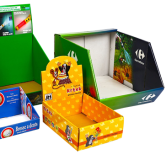



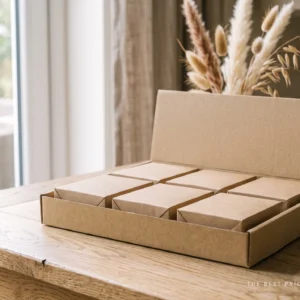

Almost every counter display ships as a sealed shipper and becomes a display at the store. It travels full, stacked on a pallet, through a distribution center. Then a member of staff pulls a perforation, lifts a front panel away, and what is left has to look like a finished piece of merchandising.
That transition is where display boxes fail, and it fails in two directions. A perforation strong enough to survive the pallet is one nobody can open cleanly by hand, so it gets attacked with a box cutter and the front edge ends up ragged. A perforation weak enough to open easily opens somewhere in transit. Getting that line right is most of the engineering on this product, and it is the reason a display should be sampled and physically opened before it runs.
The thing brands underestimate is how little time a display gets. If it takes two minutes to convert, it goes out on the counter. If it takes ten, or it needs instructions, or it needs two people, it stays in the stockroom and your campaign quietly does not happen.
That is why an auto-bottom base is worth paying for on anything that holds weight: it locks into shape in one motion rather than needing four flaps folded in sequence. Every fold you remove from the assembly is a real increase in the number of displays that actually reach a shelf.
When the shipper opens, the inside of the back panel becomes the header your product sits against. It is prime visual real estate and it is routinely left blank because the artwork was designed as if for a closed box.
Print it. A logo, a product shot or a strong flat color on that panel is the difference between a display that looks designed and one that looks like a box with the top cut off.
A counter unit holding two dozen units of anything is carrying real weight on its base and its front lip, and it carries that weight for weeks while people take from it. E flute prints beautifully and keeps the wall thin, which suits light products and detailed artwork. B flute gives noticeably more crush resistance and is the safer choice for heavier contents or a floor display that has to stand on its own.
Tell us the unit weight and how many the display holds. Those two numbers decide the board, and getting them wrong shows up as a base that sags in the middle by the second week.
| Counter display | Sits by the register. Small footprint, impulse purchase, usually holds a single line. The most common format and the one with the least space to fight for. |
|---|---|
| Shelf-ready | Opens into a tray that goes straight onto the shelf as it is. Sold on the retailer time it saves, so its measurements have to match their shelf. |
| Floor display | Stands alone in an aisle or an end cap. Holds far more, needs a genuinely stable base, and is the format most likely to need retailer approval before you make it. |
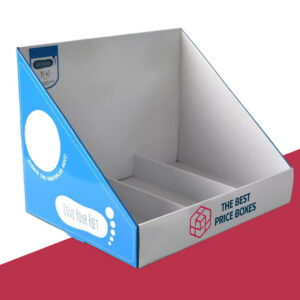
| Tray display | An open tray, sometimes stacked. Simple, quick to convert, and it works for produce, bakery and anything shoppers pick over. |
| Hanger and power wing | Hangs from a hook or a side panel. Uses space nobody else is competing for, and the hanger tab has to be reinforced or it tears out under load. |
Most chains publish a specification for what they will accept on a counter or an end cap: a maximum footprint, a maximum height, sometimes a weight limit and a required assembly time. Ask for it before the design starts rather than after the run. A display that arrives half an inch too wide for the space is not a display; it is a pallet of boxes going back.
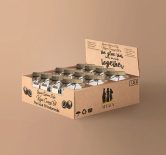
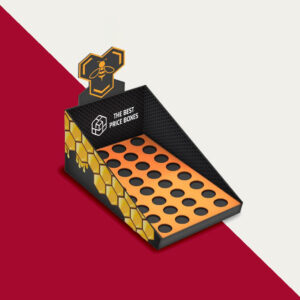
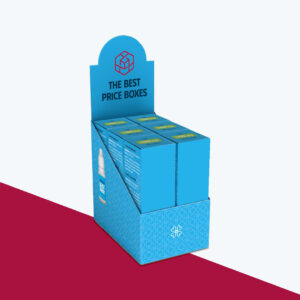
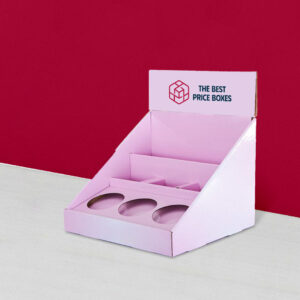
Display boxes and custom display boxes are the general starting points. Counter display boxes sit by the register, and counter displays with an auto bottom lock into shape in one motion, which is the version store staff will actually put out. Tray display boxes and display lid boxes open into a tray that goes straight onto a shelf.
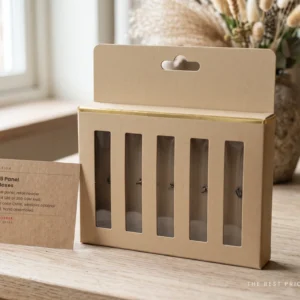
Pop-up display boxes ship flat and spring into shape, which removes almost all of the assembly time. Five-panel hanger boxes hang from a hook and use space nobody else is bidding for.
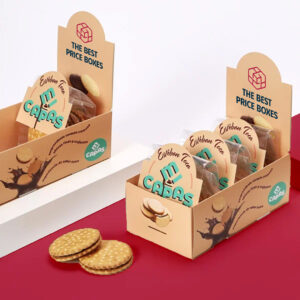
Candy display boxes, cookie display boxes and food counter display boxes are built for impulse purchases at a counter, where the product is small and the decision takes two seconds.
Cosmetic display boxes carry more finishing, because the display is competing on presentation as much as on placement. Toy display boxes hold heavier, more awkward units and need the base specified accordingly.
Pharmaceutical display boxes, medicine display boxes and CBD display boxes need label area designed in from the start rather than fitted around artwork, and they are the products most likely to face a retailer specification.
Window boxes, kraft window boxes and pillow window boxes put the product itself on show inside a closed box, which is a different way of solving the same problem: letting the shopper see what they are buying without opening anything.
No minimum order, so a single-store trial or a seasonal campaign can be run without committing to a national rollout. Displays are built to your unit size and count rather than adapted from a fixed template. Design is free, samples are free, and shipping is free.
Order a sample and open it by hand before you approve the run. It is the only reliable way to test the perforation, and it takes a minute.
PDQ stands for pretty darn quick, and it describes exactly what the format is for: a shipper that converts into a display in seconds rather than minutes. It arrives full, a panel tears away, and what is left merchandises the product. Counter PDQ units are the most common version.
They arrive as a filled or flat shipper, not as a built display. That is the point of the format — it protects the contents through the supply chain and then converts at the store. What varies is how much work the conversion takes, and that is a design decision you make when you order.
Enough that it does not look picked over after two sales, and few enough that a member of staff can lift it onto a counter with one hand. For most small impulse items that lands somewhere between a dozen and two dozen. If a retailer has given you a footprint, work backward from that instead.
A counter display is a standalone unit that sits wherever there is room. Shelf-ready packaging opens into a tray sized to slot into an existing shelf, and it is sold to the retailer on the stocking time it saves. Shelf-ready has to match their shelf dimensions; a counter display only has to fit the counter.
Ask them first. Most chains publish limits on footprint, height and sometimes weight and assembly time. Designing to their specification is straightforward; discovering it after a production run is not.