



Heading testPara bold and a link.Item oneAB


Most bakery packaging problems trace back to one thing: fat migrating out of the product and into the board. A butter croissant, a frosted cupcake, a warm donut — each will find the weak point in a box within the hour. Once grease reaches the outer surface the print goes blotchy, the panel softens, and your customer opens something that looks a day older than it is.
The board does not solve that. The barrier does. It is worth understanding that difference before you specify anything else, because it decides which stock is right for what you bake.
SBS paperboard, solid bleached sulfate, is the default for retail bakery boxes. It is bleached throughout, so it prints bright and clean and the coated print side holds fine detail. On its own it will still wick grease, so pair it with a poly coating or a grease-resistant treatment when anything buttery goes inside.
Kraft board is unbleached, strong for its weight, and the natural brown reads as small batch and handmade. It also shows every oil mark, which is why a plain kraft donut box goes translucent at the corners by mid-morning. Kraft with a grease-resistant liner keeps the look and removes the problem.
Corrugated earns its place when weight or transit are involved: tiered cakes, large dessert orders, anything shipped rather than carried to a car. E flute keeps the wall thin and prints well. B flute gives more crush resistance when boxes stack.
One honest note on recycling. Poly-coated board is not accepted curbside in most municipalities, and it is not compostable. If a compostable claim matters to your brand, the barrier has to change rather than the board, and it is better to know that at the specification stage than after a customer asks.
Footprint is the easy dimension. Height is the one that goes wrong. A box sized to the cake board rather than the finished cake will crush a buttercream shell or a drip glaze the moment the lid closes, and the bakery finds out at the counter rather than in the kitchen.
Measure the tallest point of the finished product, decoration included, then add clearance. For cupcakes that means the top of the swirl, not the top of the case. For anything tiered, a taller box with an internal support beats a shorter box every time.
| Auto-bottom | Also called crash lock. Pops open and locks in one motion. If someone is folding boxes at five in the morning, this is the structure that pays for itself in labor. |
|---|---|
| One-piece tuck top | Ships flat, folds quickly, and suits lighter items and short carries. |
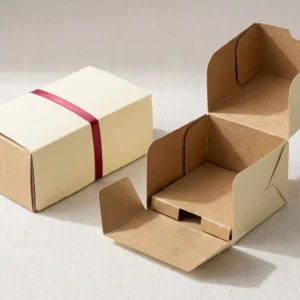
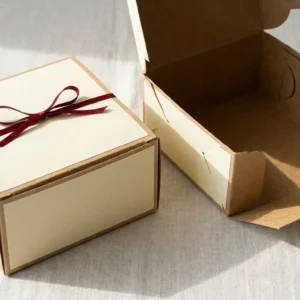
| Two-piece lid and base | Slower to assemble and much better to open. Worth it for gift work and anything presented rather than handed over. |
| Lock corner with insert | For anything that must not slide: cupcakes, macarons, cake slices, single-serve desserts. |
| Window box | Sells the product before it is opened. Choose a film patch to keep dust and moisture out, or an open cut where a warm item needs to vent. |
Every box below is printed to your artwork and cut to your size. Start with the closest match and we will adjust the dimensions rather than push you toward a stock size that nearly fits.
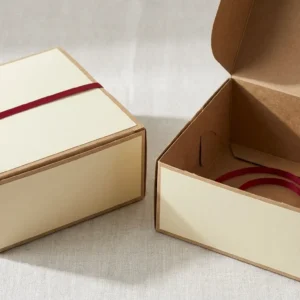
Cake boxes cover the everyday range. Custom printed cake boxes when the artwork is doing the selling, tall cake boxes for tiered and decorated work that needs headroom, and cake slice boxes for single servings and takeaway counters. Cheesecake boxes handle a denser, colder product that sweats in transit. Cake and bakery boxes and collapsible bakery boxes suit bakeries short on storage, since collapsible stock stores flat until the rush.
Kraft cupcake boxes with an insert stop the swirl meeting the lid. Muffin boxes run larger in the cavity and usually want venting. Pastry boxes are where a grease-resistant liner matters most, because laminated dough carries the most butter of anything on this page.
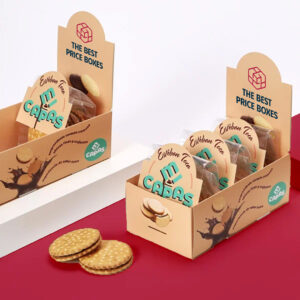
Cookie boxes for gifting and mail order, cookie display boxes for counter and point-of-sale, and cookie bags where a box is more packaging than the sale needs.
Donut boxes and kraft donut boxes for the dozen and half dozen. Donut tray boxes and donut trays keep glaze off the lid, which is the single most common complaint on a filled or iced order.
Macaron boxes and kraft macaron boxes with fitted inserts, brownie boxes for cut squares and sheet-pan bakes, and pancake boxes for stacked breakfast service.
There is no minimum order. If you want fifty boxes to test a seasonal design before committing to a full run, that is a normal order here, not an exception. Sizes are cut to your dimensions rather than chosen from a fixed list, design is free, samples are free, and shipping is free.
Reorders run from the approved file, so the second run matches the first without a new proof cycle.
Two different markets answer to that phrase. Stock distributors sell plain white or kraft boxes in packs, which is the fastest route if you do not need your name on them. Custom printers, which is what we are, produce boxes to your size and artwork with your branding on them. If your boxes are going home with a customer, the printed route is doing marketing work the plain one is not.
Craft retailers do carry small quantities of plain bakery boxes, and for a one-off bake sale that is a sensible place to go. It stops working when you need a specific size, a grease barrier for what you actually bake, or your logo on the lid. That is the point at which a custom run makes sense.
Yes, on almost any structure here. Decide first whether the window is sealed with film or left as an open cut. Film keeps dust and moisture out and shows the product cleanly. An open cut lets a warm item release steam, which stops a glaze going tacky, but it will not protect against handling.
Yes. Tell us what is going inside when you order and the board, barrier and inks are specified for direct food contact. A barrier suited to a dry cookie is not the one a warm, filled donut needs.
No. Standard sizes exist because they suit the factory, not because they fit your product. Send the dimensions of what you bake and the box is built around it.


We are here to help you 7 days a week and respond within 24 hours. Plus, you can find most answers to your questions right on this page.