

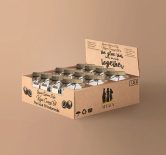
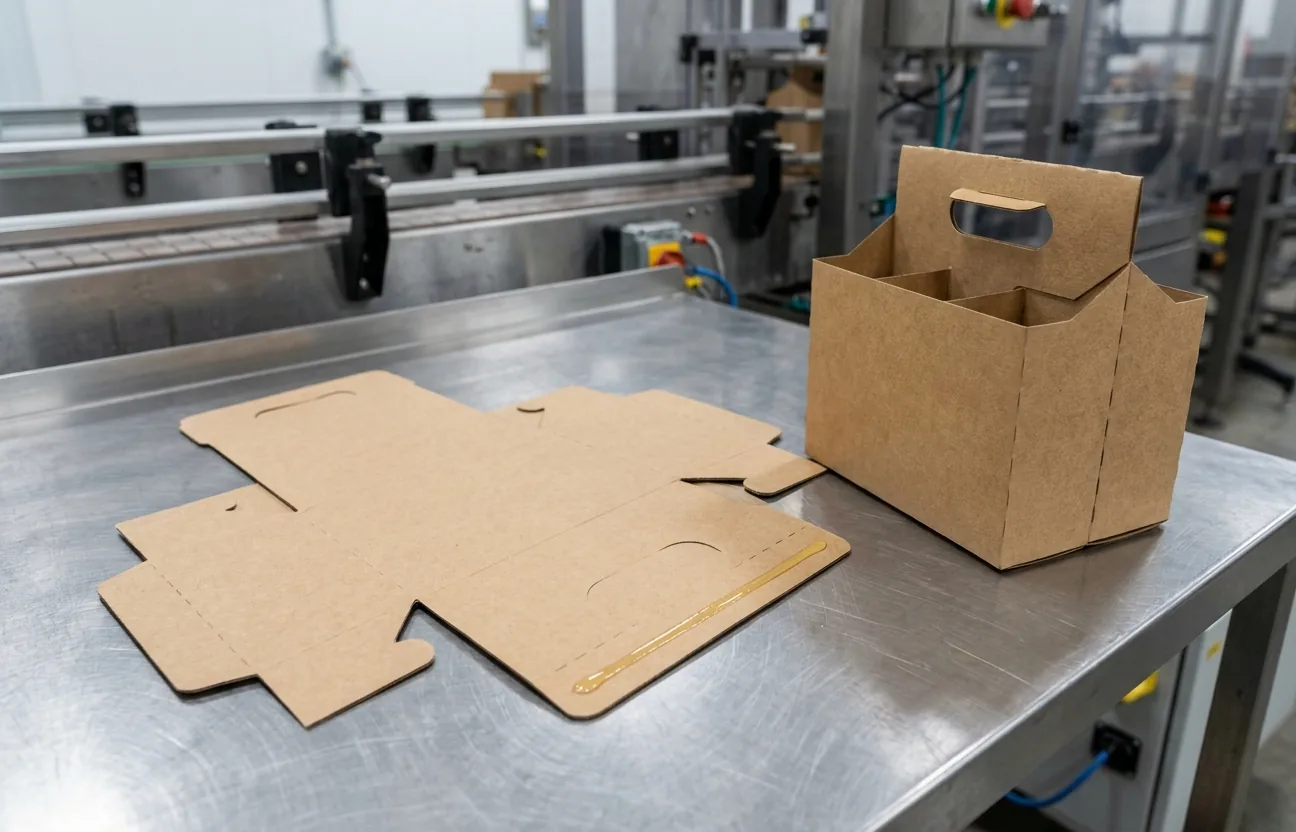
There are three kinds of 4 pack and 6 pack can carriers: a paperboard wrap that locks onto the can rims, a paperboard basket with a center handle, and a plastic or paperboard clip that grips only the tops of the cans. Which one you need depends on the can size, whether the pack will sit in ice, and how much of the pack should be printed board rather than visible can. This guide walks through each with the can dimensions, the weight they carry and the trade-offs that decide it.
Every carrier here can be printed in any quantity with no minimum order from the custom beverage boxes page. The broader structure and board choices are in the beverage folding cartons guide; this page stays on four and six packs.
The three carrier families
| Carrier | How it works | Strengths | Watch out for |
|---|---|---|---|
| Paperboard wrap | A printed band, usually 3 to 4 in tall, wraps the middle of the cans. Die cut locks hook under the can rims to stop cans dropping out. | Six printed faces, full brand control, recyclable with the paper stream, ships flat. | Drawn to one exact can. Rim locks are the failure point if the board is too light or the can changes. |
| Paperboard basket | A glued partition splits the cans into cells and rises into a handle above them. | Strongest paperboard option, works for glass, easy to hand load, cans and bottles are fully visible. | Takes more shelf and cooler space. Fewer flat printed panels than a wrap. |
| Clip (plastic or paperboard) | A molded ring or a folded paperboard clip snaps onto the rims and lifts the pack from the top. | Fastest to apply, cheapest per pack at volume, cans fully visible. | Almost no room for branding. Plastic rings raise recycling questions; paperboard clips need specialist tooling. |
Can sizes and why a carrier fits one and not another
A can carrier is drawn to a specific can. The rim lock on a wrap and the cell width on a basket are both cut to a diameter, and the common US cans are not interchangeable.
| Can | Typical use | Approximate body diameter | Approximate height |
|---|---|---|---|
| 12 oz standard (211 x 413) | Soda, most beer | 66 mm | 122 mm |
| 12 oz sleek (204 x 503) | Hard seltzer, sparkling water, energy | 58 mm | 145 mm |
| 16 oz standard (211 x 603) | Craft beer, tallboys | 66 mm | 157 mm |
| 8.4 oz slim (202 x 504) | Energy shots, mixers | 53 mm | 133 mm |
| 19.2 oz stovepipe (211 x 710) | Single serve beer | 66 mm | 180 mm |
The number in brackets is the can maker’s size code in inches and sixteenths. A 211 body is 2 and 11/16 in across. Two cans with the same body code can still differ at the rim, because the neck taper varies by can maker and by whether the can is a standard or a 202 end. Send us one physical can with the order and we check the rim lock against it before the first proof goes out.
How much weight a paperboard handle really carries
Four 16 oz cans weigh about 4.4 lb full. Six 12 oz cans come to about 5.2 lb. A wrap made from 18 pt wet-strength coated unbleached kraft carries either of those comfortably, provided the handle is reinforced with a second layer of board where the fingers go. The problem is never the dry carrier on the shelf. It is the same carrier after two hours in a cooler of melting ice. Standard recycled board loses about half its strength when saturated; a wet-strength board keeps most of it. If your packs will ever be iced, specify wet-strength and do not let anyone talk you into a lighter board to save a small amount per carrier.
Kraft or white
A natural kraft carrier prints warm and muted and hides scuffs from the cooler well. It suits craft beer, cider, cold brew and anything sold on a natural story. A white coated board gives you accurate color, which matters for a brand red or a pale pastel that a hard seltzer lives on. Both are the same structure and the same lead time; the choice is a brand decision, not a technical one. We send free swatches of both, see packaging samples.
One carrier, many flavors: how small breweries keep it affordable
A brewery with eight beers does not need eight carriers. The usual approach is to print a single carrier design with the brand and a blank flavor window, then apply a flavor label or a small printed belly band per beer. The second approach, which suits short runs better than you might expect, is to print the carriers digitally so that each flavor is its own short run with no plate cost. For a mixed four pack, print one variety carrier and let the cans carry the flavor. The guide to logo printing methods explains where digital, offset and flexo each make sense.
Hand loading versus a line
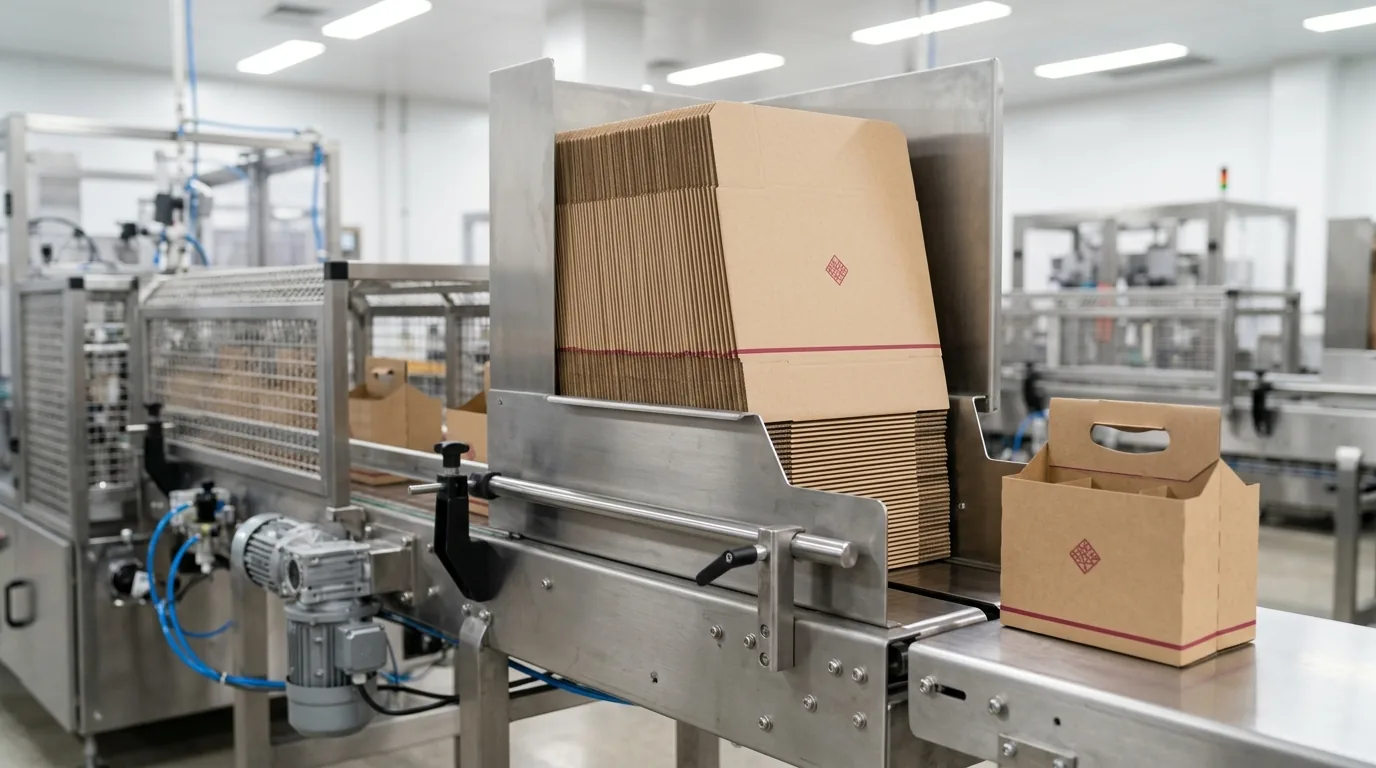
Tap rooms and small canning runs load carriers by hand. For a wrap, that means folding the sleeve around four cans and pressing the locks over the rims, which takes a practiced person a few seconds. Baskets are pre-glued and pop open, so loading is faster and easier on the hands. If a mobile canner or a co-packer will apply carriers on a machine, tell us the machine, because a machine-applied wrap has different lock geometry and different glue positions from a hand-applied one. The co-packer secondary packaging guide has the list of what a line needs.
What to put on the carrier
Beyond the brand, leave room for the pack UPC, the container deposit statement for the states that require one, alcohol by volume and the government warning if the product is alcoholic, and the recycling mark you are entitled to use. Check the required text with your compliance advisor before the proof is approved; the artwork guide at box design and artwork setup shows how to keep that text clear of the locks, the handle and the glue flap.
What to send for a quote
- Can size, and ideally one empty can
- Pack count: 4 or 6, and the arrangement
- Carrier type: wrap, basket or clip
- Kraft or white board
- Number of flavors and whether they share a design
- Quantity and the date you need them
- Hand loaded or machine applied, with the machine model if known
- Artwork, or a note that you want free design help
There is no minimum order, every job includes a free dieline and digital proof, and shipping is free. Request a quote and a specialist replies within one business day.
Can carrier FAQs
Will a 12 oz carrier fit 16 oz cans?
No. A 12 oz standard and a 16 oz can share a body diameter but not a height, so a wrap drawn for one sits at the wrong point on the other and a basket will be too short to hold the pack safely. Each can size gets its own dieline.
Can a paperboard 4 pack carrier go in a cooler of ice?
Yes, if it is made from wet-strength board. Standard recycled paperboard softens and the handle can tear once it is saturated. Ask for wet-strength coated unbleached kraft for any pack that will be iced.
Which is stronger, a wrap or a basket carrier?
A basket carrier is stronger for the same board because the load hangs from a glued center partition rather than from rim locks. Wraps are perfectly strong for cans on the correct board, but glass bottles usually belong in a basket.
What is the minimum order for custom 6 pack carriers?
There is no minimum at The Best Price Boxes. A single tap room release of a few hundred carriers and a distributor order of tens of thousands both get a free dieline, a digital proof and free shipping.
Are plastic can rings being replaced?
In many markets yes. Paperboard clips and wraps are replacing plastic rings because they recycle with paper and avoid the wildlife concerns attached to rings. If your customers ask about plastic-free packaging, a printed paperboard wrap answers the question on the shelf.