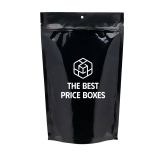
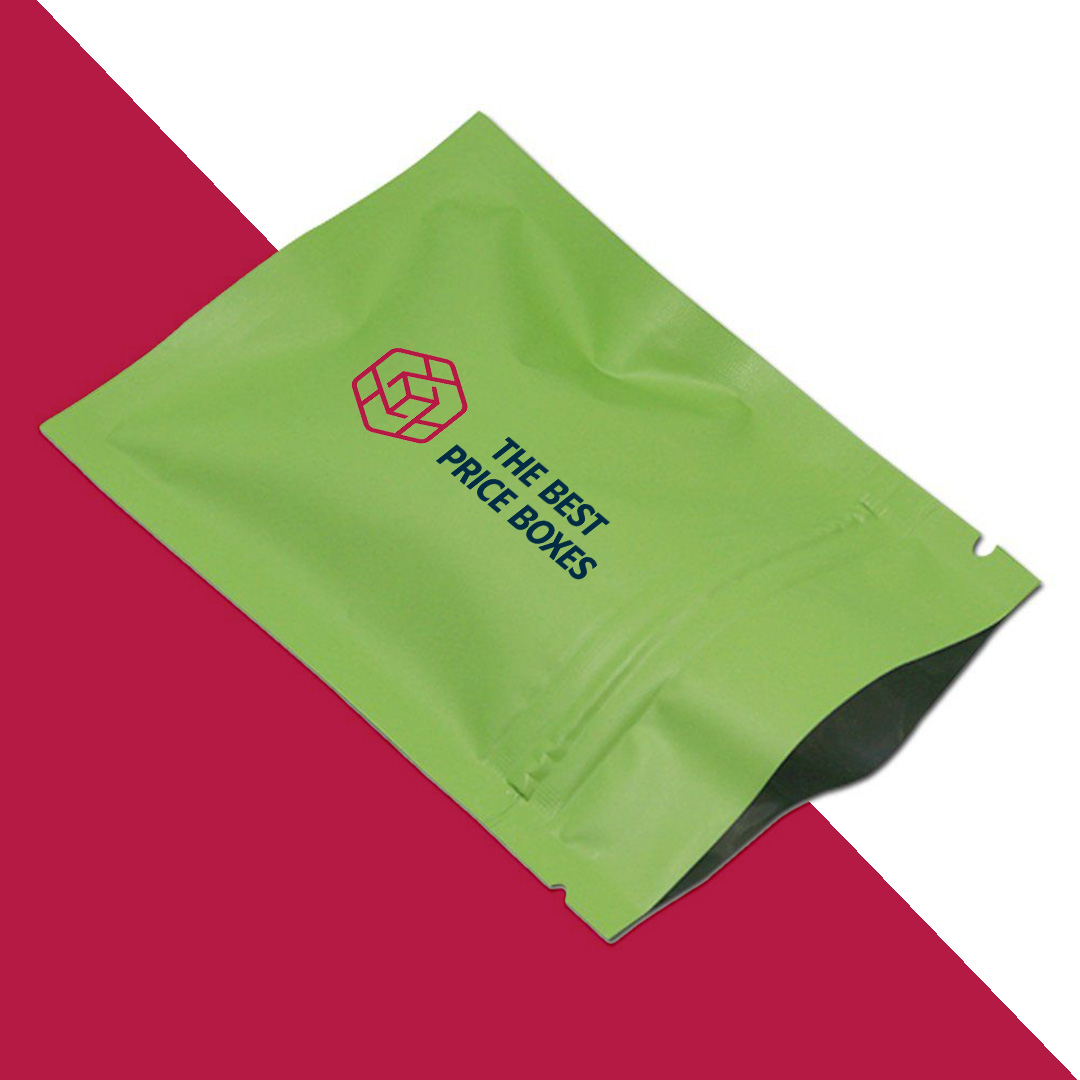
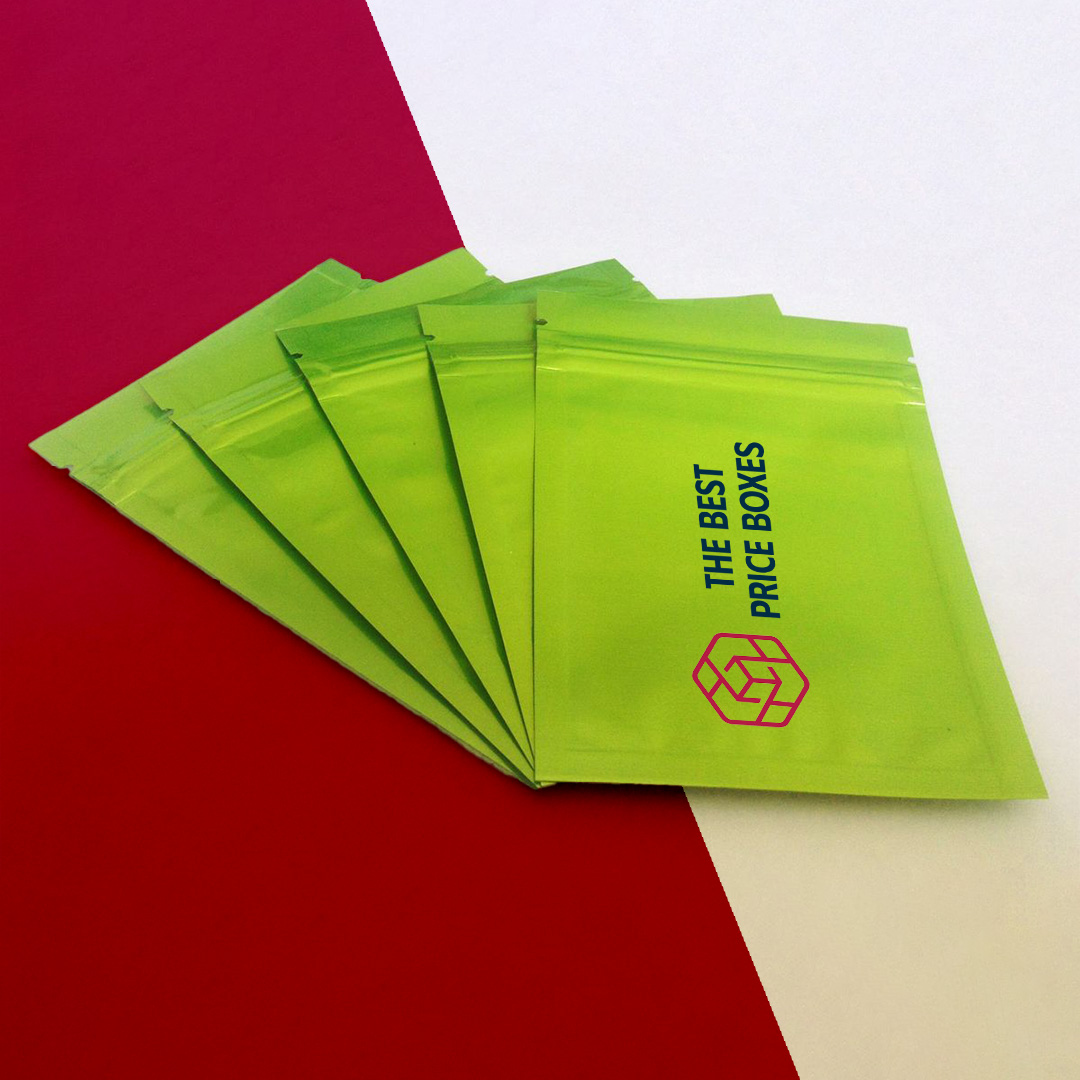
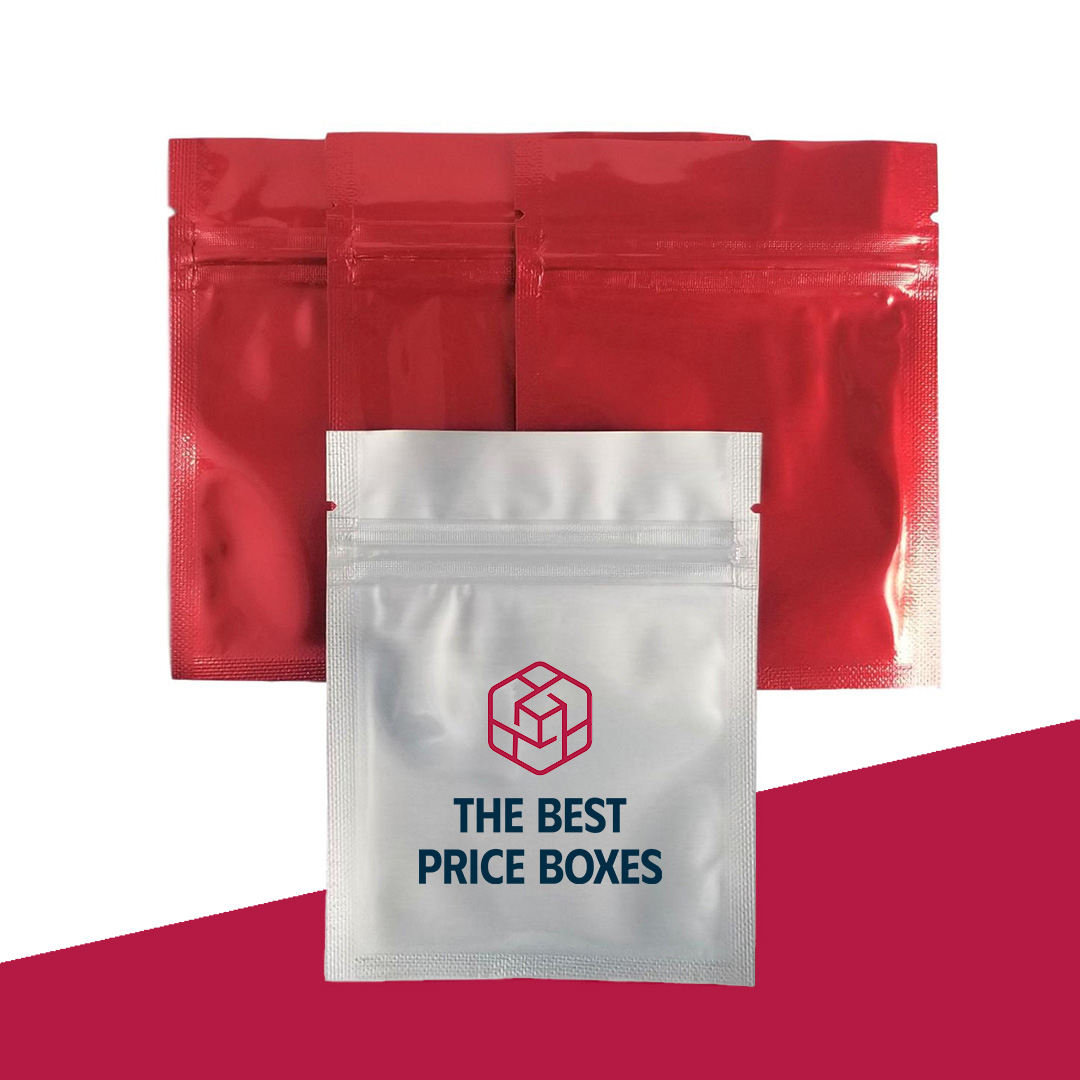
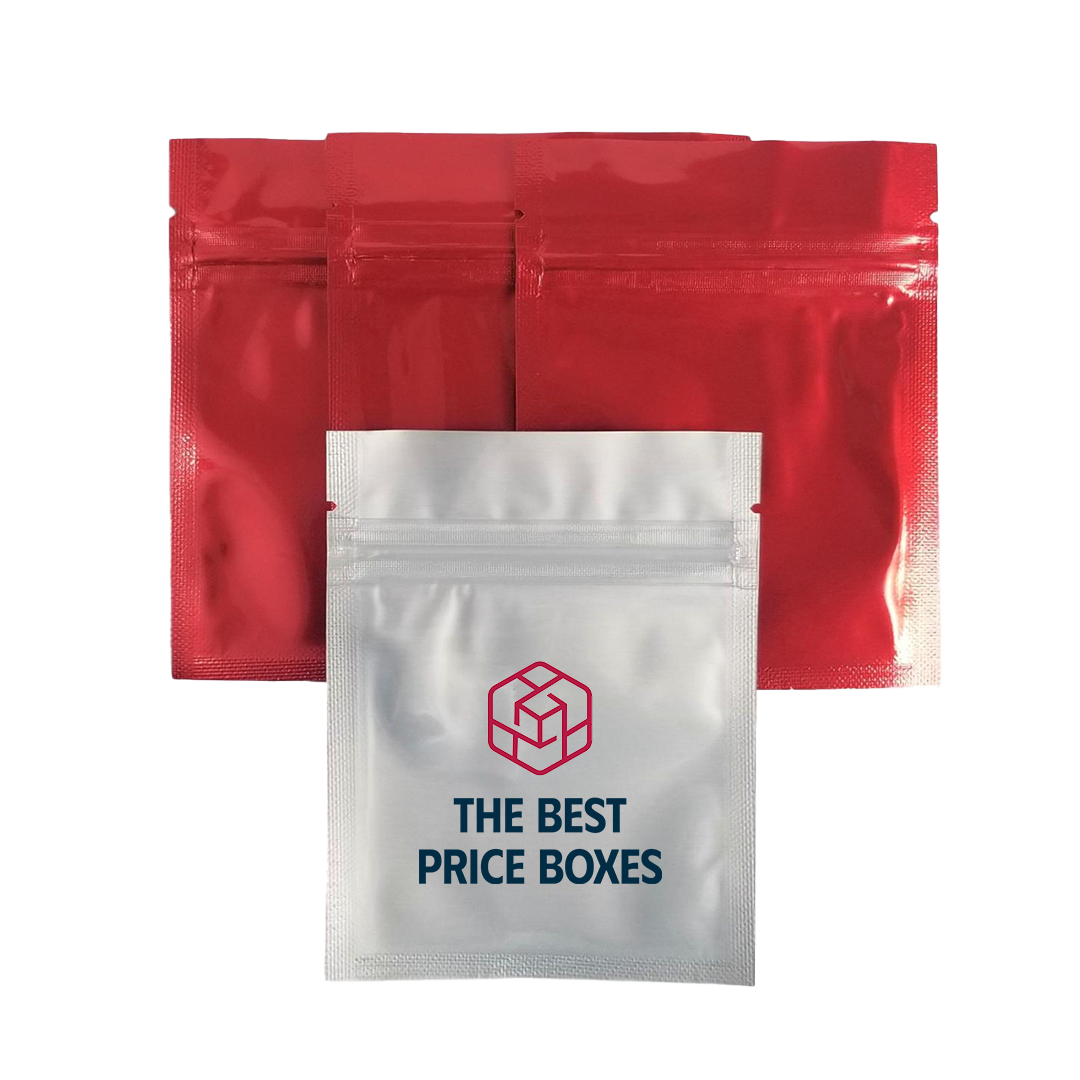
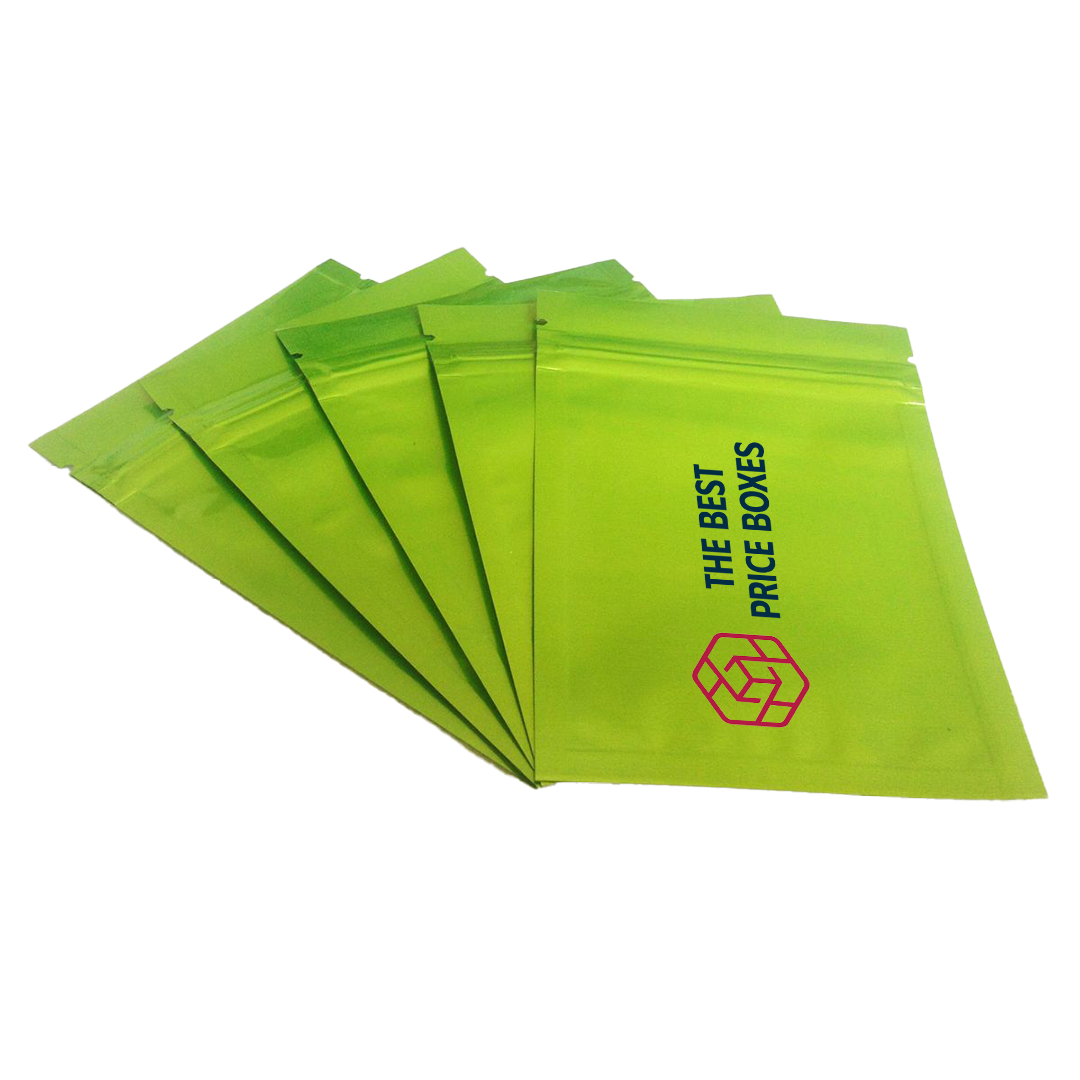
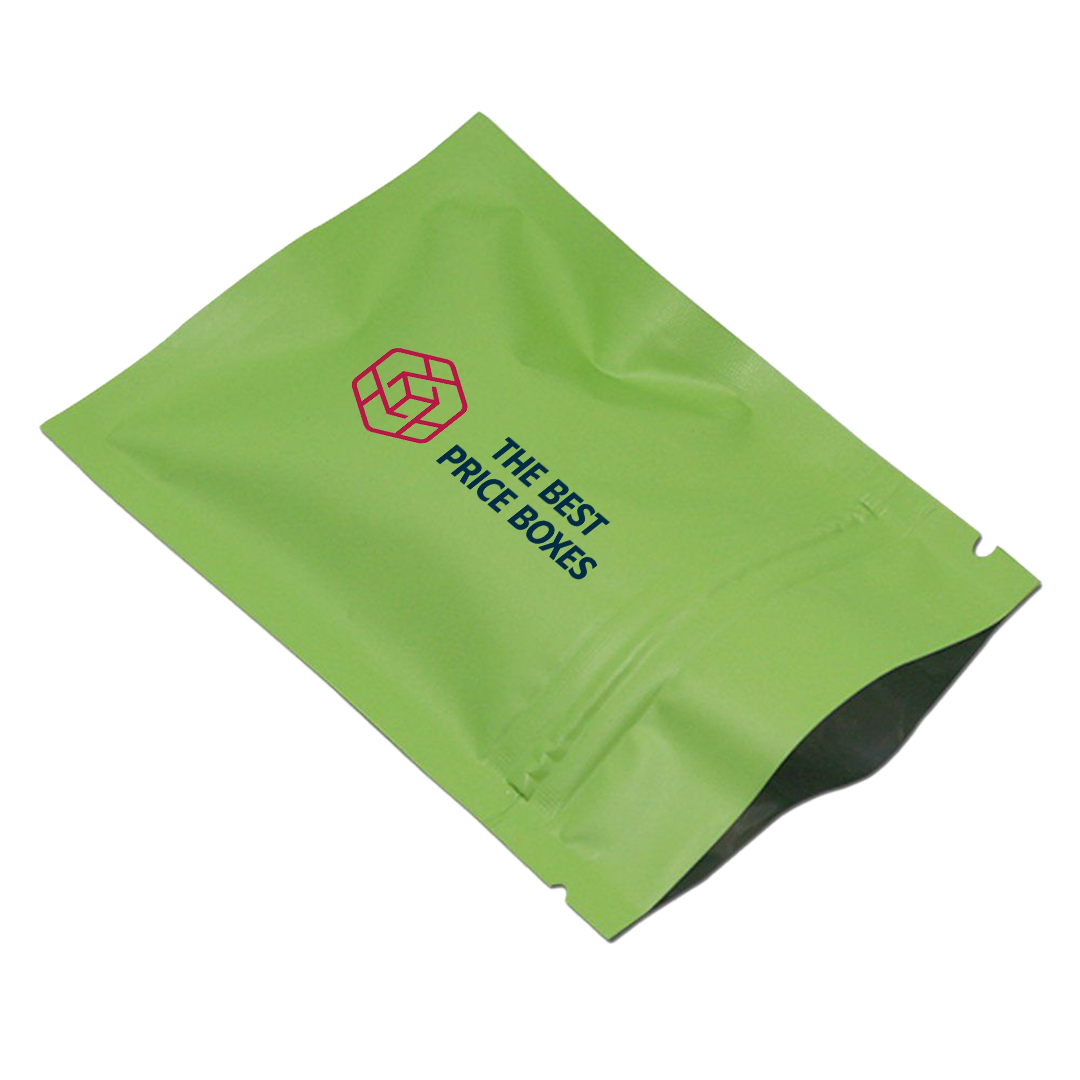
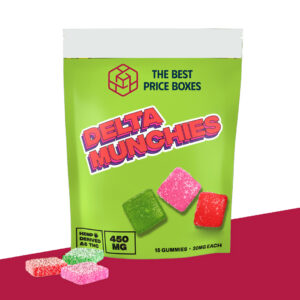
Preserve your products for ages by keeping them safe, dry, and fresh for years with our tamper-evident, odor-resistant, and puncture-proof 3.5 mylar bags.
No minimum order.
Pricing depends on size, material and quantity. Tell us what you need and a specialist replies within one business day with a firm quote, a free dieline and a digital proof. No minimum order, free shipping.
Standard production runs 7 to 14 business days, depending on the box style, print method, and finishing you choose, a simple kraft mailer moves faster than a box with foil stamping or spot UV. Need it sooner? We handle rush requests case by case, so email us your deadline before you place the order and we’ll tell you straight whether we can hit it.
Shipping is free on every order, in the United States and internationally. We ship with FedEx, UPS, USPS or DHL depending on your location and order size, and you’ll get a tracking number as soon as your order leaves our facility.
Standard turnaround: 7 to 14 business days
Rush orders: handled case by case, contact us with your deadline
Shipping: free worldwide via FedEx, UPS, USPS, or DHL
Tracking: provided once your order ships
Ready to order 3.5g mylar bags? Get your free quote in minutes
Free design and dielines, free samples, no minimum order, and we beat any competitor’s written quote. Your logo in full color, fast turnaround.
The 3.5 by 5 inch mylar bag is the small workhorse of the pouch world. It is the size brands reach for when the product is a single serving, a sample, an eighth, a set of gummies, or anything where a full size stand up bag would swim around half empty and look cheap. Small and filled always beats big and slack on a shelf.
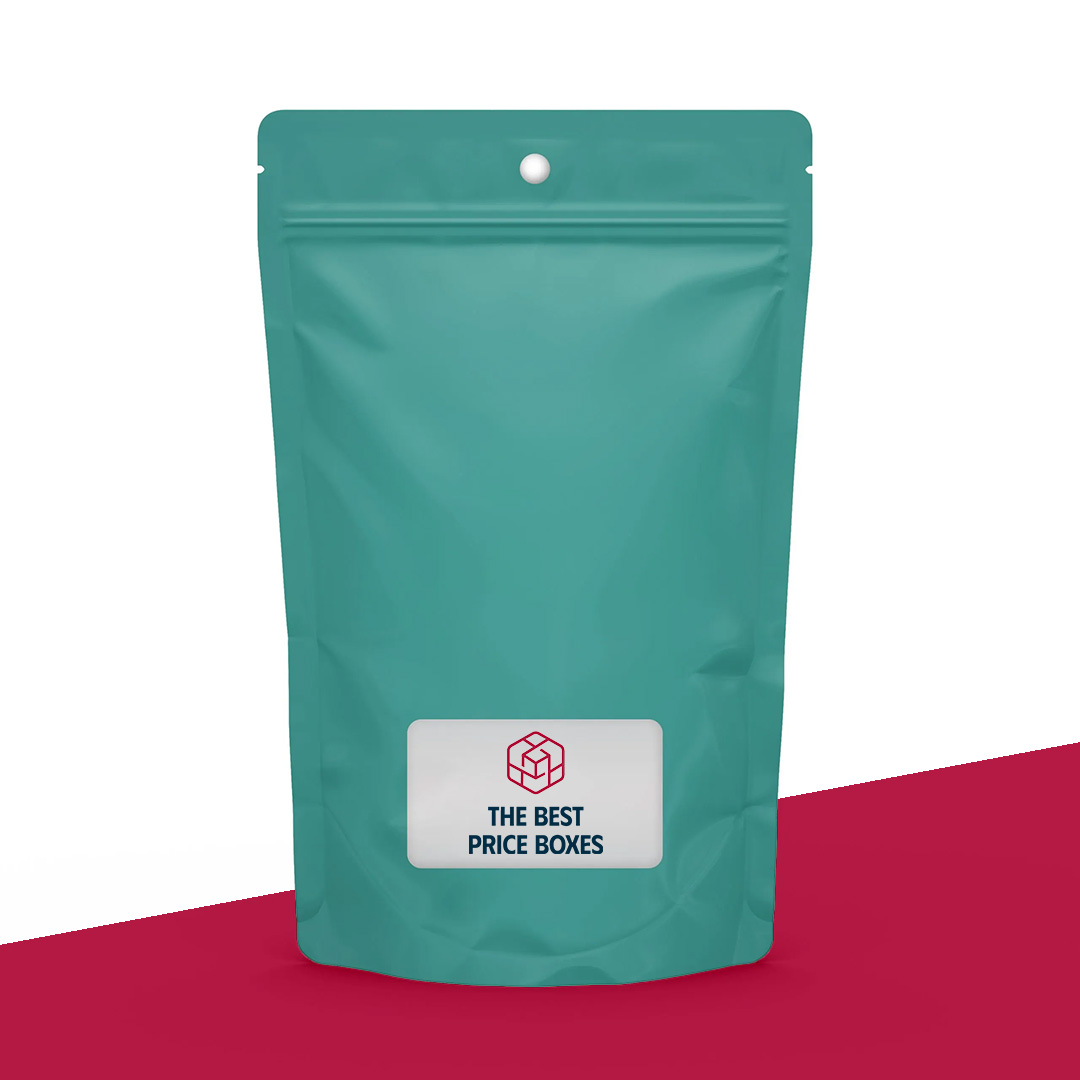
We make this size as a flat or stand up mylar pouch with a resealable zipper, a hang hole for peg display, and a full barrier that blocks light, air, and odor. It is a favorite for edibles, supplements, spice blends, seeds, and sample packs because it holds a small quantity snug and prints like a premium product at a tiny unit cost. Matte, gloss, metallized, and clear window options are all on the table.
There is no minimum order, so you can run a sample or single serve size without committing to thousands of units. Tell us the fill weight and whether you want a window or a hang hole and we will confirm the 3.5 by 5 works for your product or point you to the next size up.
When a small pouch beats a big one
What fits in a 3.5 by 5 inch mylar bag?
Single servings and small quantities, samples, gummies, an eighth, spice blends, seeds, and supplement counts. It keeps a small fill snug so the bag does not look half empty.
Does this small bag still block light and odor?
Yes. Even at this size a full metallized barrier blocks light, air, and odor. We will match the barrier level to how long the product needs to stay fresh.
Can it hang on a peg display?
Yes, we can add a hang hole and a resealable zipper. It is a popular format for checkout and impulse displays.
Is there a minimum order?
No minimum, so sample and single serve runs are easy to test before you scale up.
A 3.5 gram mylar bag is normally 3.5 by 5 inches, and 4 by 6 inches where the product is bulky for its weight. Bags are sized by volume rather than by weight, so the right size depends on how much room your product actually takes up, and the aim is to fill roughly 70 to 80 percent of the bag. Film for an eighth usually runs 3 to 5 mil, with 4 mil the common choice. Metallised polyester and foil laminate both reach high barrier, and the better of the two depends on how roughly the bag will be handled rather than on the barrier figure alone. Free design, free dielines and free samples on every order, with no minimum.
Learn More About 3.5 Mylar Bags
What size mylar bag actually holds 3.5 grams
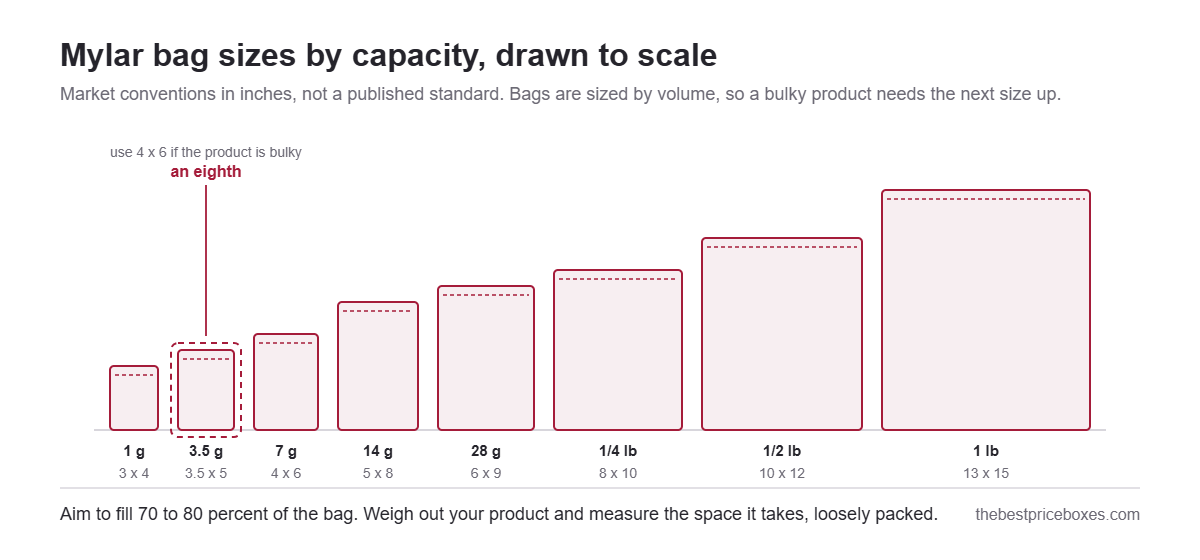
The size most of the industry settles on for an eighth is 3.5 by 5 inches. That is the figure you will see repeated across suppliers, and it is the one to start from. Plenty of brands move up to 4 by 6 inches, and there is a good reason for that which we come to below. The full ladder, so you can size the rest of a range at the same time:
Capacity
Bag size, inches
1 g
3 x 4
3.5 g, an eighth
3.5 x 5
7 g, a quarter
4 x 6
14 g, a half
5 x 8
28 g, an ounce
6 x 9
Quarter pound
8 x 10
Half pound
10 x 12
One pound
13 x 15
Every size in proportion. An eighth is the second from the left.
These are conventions rather than a standard. No body publishes an official size for an eighth the way NMFC publishes board grades for corrugated. They are what the market has converged on, and they work because most products at a given weight take up a similar amount of room. Most, not all.
Why 3.5 grams is not one size
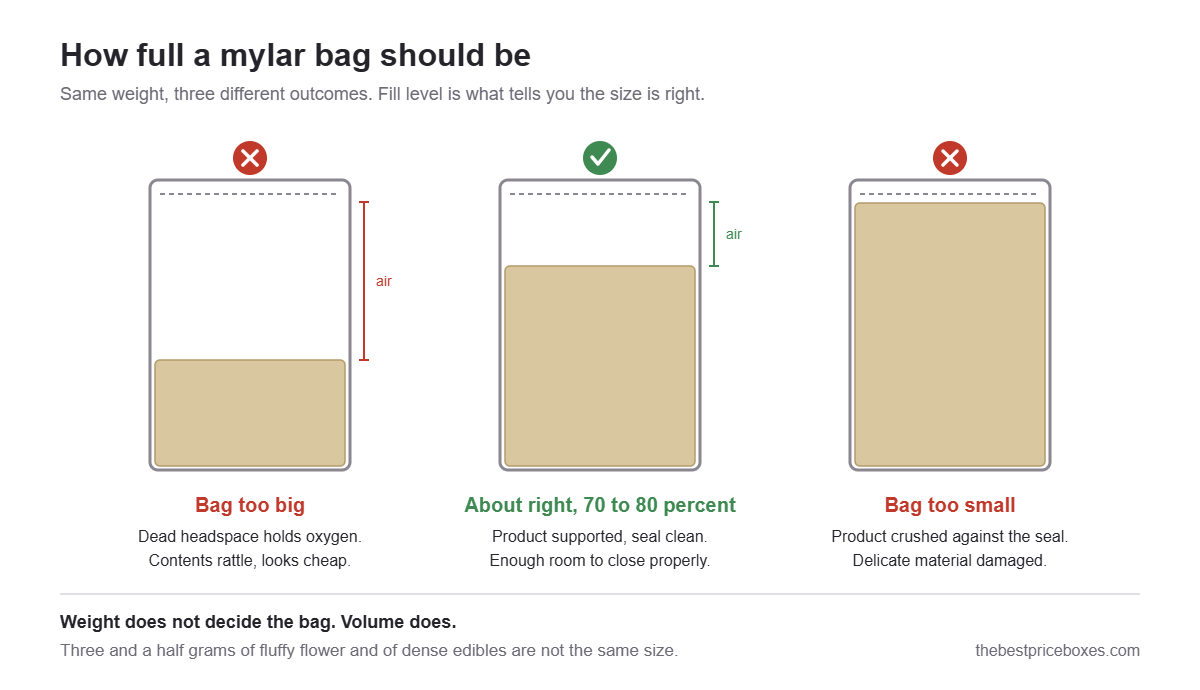
Weight and volume are different things, and a bag is sized by volume. Three and a half grams of dense, tightly cured flower and three and a half grams of light, airy flower are the same weight and nowhere near the same size. Gummies, ground material and pre rolls at the same weight fill the bag differently again. The working target is that your product should fill roughly 70 to 80 percent of the bag. Under fill it and you get a bag of mostly air, which looks cheap on a shelf, wastes headspace that oxygen can sit in, and lets the contents move around. Over fill it and you compress the product against the seal, which damages delicate material and makes the bag hard to close cleanly.
Under filled, right, and over filled. Weight does not decide the bag, volume does.
That is the whole reason a lot of brands run 4 by 6 for an eighth. If your product is fluffy, 3.5 by 5 is too tight, and the answer is a bigger bag rather than a heavier hand. The reliable way to settle this is to weigh out 3.5 grams of the actual product and measure the space it occupies loosely packed. Send us that and we will size to it.
How thick the film needs to be
Film thickness is quoted in mils. One mil is a thousandth of an inch, and it describes the whole laminated wall, not any single layer inside it. For an eighth, common practice sits between 3 and 5 mil, with 4 mil the usual choice. Thinner than that and the bag feels flimsy and is easier to puncture. Thicker than that and you are paying for material that a small pouch does not need, and the bag becomes stiff enough to fight the seal. Mil is a measure of thickness, not of barrier. A thick bag with a poor structure will let more oxygen through than a thin bag with a good one. The two are worth keeping separate in your head, which brings us to the numbers that actually describe barrier.
The barrier numbers, and what they mean
Two measurements describe how well a pouch keeps the outside out.
OTR, the oxygen transmission rate. How much oxygen passes through a given area in a day. Usually quoted as cc per square metre per 24 hours, or cc per 100 square inches per 24 hours, and normally tested at 23 degrees Celsius and 0 percent relative humidity. Lower is better. A structure is generally called high barrier below 1 cc per 100 square inches per 24 hours, which is about 15.5 cc per square metre.
MVTR, the moisture vapour transmission rate. How much water vapour gets through, in grams per square metre per 24 hours, normally tested at 37.8 degrees Celsius and 90 percent relative humidity. Lower is better here too. Typical published figures for the two structures used in this kind of pouch:
Metallised polyester, often written VMPET. Around 1.2 cc per square metre per day for oxygen and around 0.8 grams per square metre per day for moisture, measured unflexed. Comfortably inside high barrier territory.
Aluminium foil laminate. Effectively zero on both counts when the foil is undamaged, because foil is not permeable at all. Anything that gets through a foil laminate is going through a defect, not through the material. Those figures are typical values published by film suppliers rather than a test of any particular bag. Barrier is a property of the finished laminate, so the honest way to quote it is against the exact structure you order. Ask us and we will get the figures for the structure we are proposing rather than repeat a number off a chart.
Foil is the better barrier and it is not always the better bag
On paper foil wins, and it is not close. In practice the comparison is more interesting. Foil has no permeability, so its barrier is perfect until it is damaged. The catch is that it damages. Aluminium can develop micro fractures at fold lines, and once there is a crack there is a hole, and a hole makes the barrier figure meaningless. Metallised polyester has microscopic pinholes built in from the vacuum deposition process, which is why its numbers are slightly worse to begin with, but it resists cracking through repeated flexing far better. So the question is not which has the better number. It is whether your bag is going to get folded, crushed into a pocket, shipped loose in a mailer or handled repeatedly. A bag that will lead a rough life may hold its barrier better in metallised polyester than in foil, even though foil starts ahead.
Child resistant closures
If the contents require child resistant packaging where you are selling, the closure has to be certified, and certification belongs to the finished package rather than to the film. The two references you will see are 16 CFR Part 1700, the testing procedure under the Poison Prevention Packaging Act, and ASTM D3475, which classifies child resistant package types. A supplier should be able to give you a certification letter naming the standard the package was tested against. Ask for it, and treat a bag described as child proof with no certificate behind it as a bag that has not been tested. We will tell you plainly whether a given closure is certified and supply the letter where it is. Where it is not, we will say so rather than borrow the word.
What to send us
Four things get you an accurate quote and a bag that fits.
The product and its actual bulk. Weight alone is not enough. Tell us what it is and, if you can, how much room 3.5 grams of it takes.
Where it is being sold. This determines whether the closure needs certifying and what has to appear on the artwork.
How it travels. Shelf, mailer, pocket. This is what decides foil against metallised polyester.
Your artwork, or nothing at all. Design and dielines are free either way, so an idea is enough to start from. Free samples are available before you commit to a run, and the unit price falls as the run gets larger, because setup is a fixed cost spread across the order. Related reading: the packaging glossary covers the terms used above, and our corrugated specification reference takes the same approach to board grades. For the barrier side in more detail, including the unit conversions and what counts as high barrier, see our mylar barrier specification reference.
You’ve successfully crafted an outstanding product, and now it’s our turn to contribute by designing distinctive custom packaging materials. Explore our array of boxes to discover the perfect match for your requirements!