





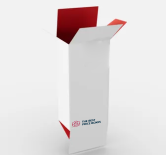
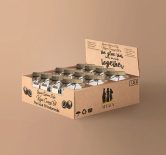
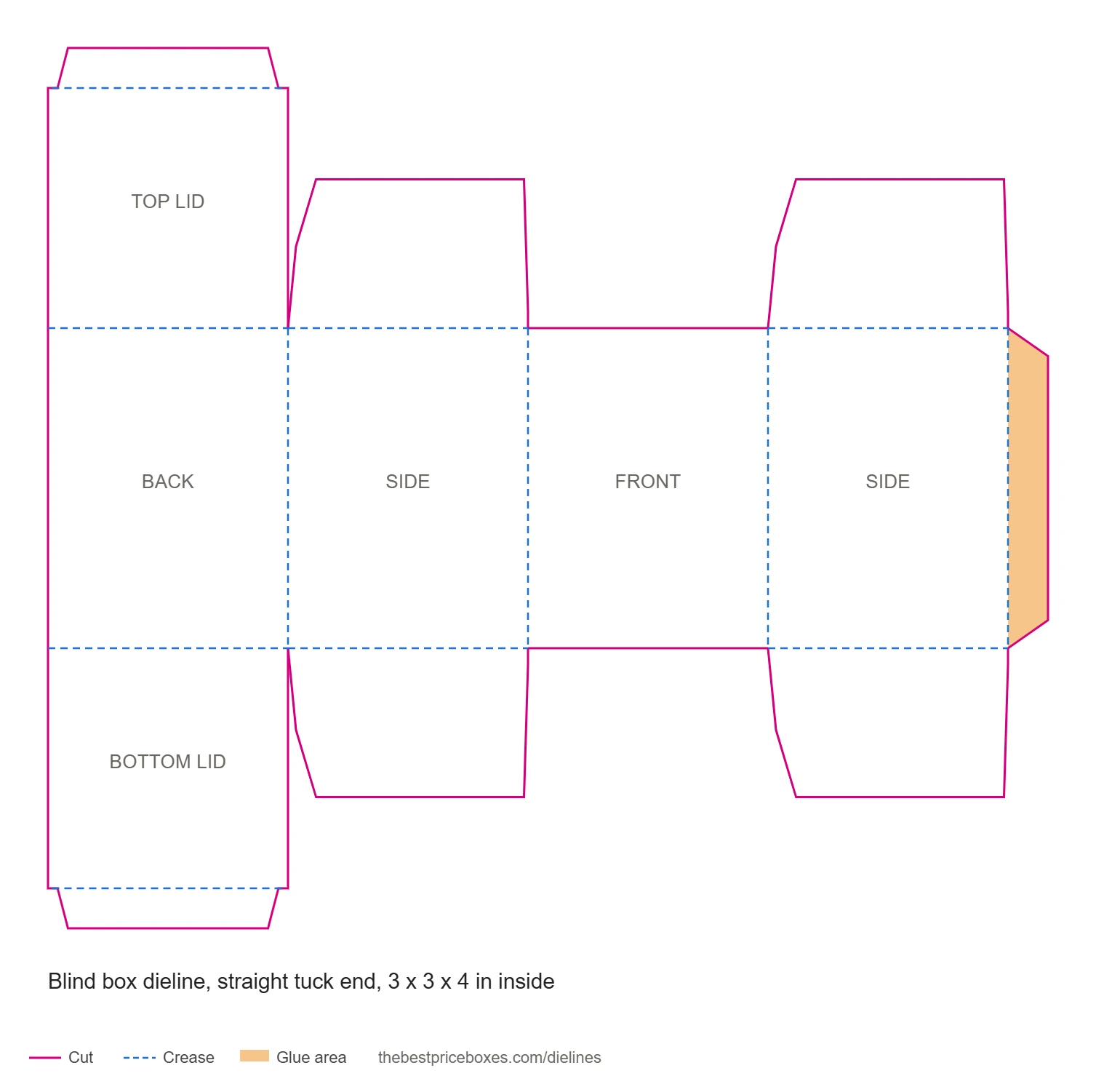
A blind box template is the flat dieline for the small sealed carton a blind box figure is sold in: usually a straight tuck end box with a lid at the top and bottom of the back panel, two dust flaps at each end and a glue flap along one side. It folds into a cube or short rectangle that looks identical for every figure in the series. This page has a free printable template for paper prototypes, the production layout, three common blind box sizes and how to set up artwork, and you can request the file in your exact size for free.
Two sizes on letter paper: a mini 1.75 x 1.75 x 2.5 in box and a standard 2 x 2 x 3 in box, with cut, fold and glue lines marked. Print at 100% on card stock, cut, fold and glue. For paper prototypes, crafts and mockups only, not for production printing.
Download the free printable (PDF)
Making blind boxes to sell? Get a production dieline in your exact size, free.
Send the inside size you need, or the size of your figure in its bag, and a specialist replies within one business day with a production-ready dieline: vector PDF that opens in Adobe Illustrator, plus SVG and DXF. We also make the boxes, foil-lined or printed inner bags and counter displays.
Request this template
Common blind box sizes
| Inside size | Typical contents | Flat size, inches | Flat size, mm |
|---|---|---|---|
| 2.5 x 2.5 x 3.5 in | Mini figures, keychains, mini squishies | 10.5 x 9.5 | 267 x 241 |
| 3 x 3 x 4 in | Standard vinyl and PVC mini figures | 12.5 x 11.0 | 318 x 279 |
| 3.5 x 3.5 x 4.5 in | Larger figures, squishies, plush charms | 14.5 x 12.5 | 368 x 318 |
Sizes are inside dimensions, length x width x height. Flat sizes are nominal, before the allowance for board thickness. The production file we send is adjusted for your board.
How to read the layout
| Line | Meaning | What to do with it |
|---|---|---|
| Solid magenta | Cut | The knife follows this line. Nothing outside it survives. |
| Dashed blue | Crease | The board folds here. Keep small text and fine lines off it. |
| Orange fill | Glue area | Leave it free of ink and coating so the glue bonds to bare board. |
The production file we send also carries bleed and safe zone lines set for your job. Your free digital proof confirms both before anything prints.
Setting up blind box artwork
- Lock the dieline on its own layer and build artwork underneath, in CMYK with any spot colors named.
- Use one design for every box in the series. Put the lineup of designs on the back panel, with the secret figure as a silhouette.
- Turn the lid panels to read correctly once folded. The top lid usually needs rotating 180 degrees.
- Leave a clear area for the tracking code and the country of origin, which a sealed box has to show. Our toy labeling guide lists what goes on it.
- Plan a seal sticker across the top tuck if you want tamper evidence, and keep critical art out from under it.
- Outline fonts, embed images at 300 dpi or better and export a vector PDF with the dieline layer in place.
The print-ready artwork guide goes through each step in more detail.
Sizing the box to the figure
Measure the figure in its inner bag, not bare, because a foil-lined or printed bag adds bulk. Then add a little clearance so the bag is not crushed. If the checklist card sits in the box too, it needs room against one wall. Send us those numbers and we draw the template to them. The series planner works out how many boxes, bags and displays your run needs.
Printing the free template
- Print at 100% or "Actual size". "Fit to page" shrinks the box.
- Use card stock around the weight of a greeting card. Copy paper folds, but the box will be floppy.
- Score the dashed lines with a dull knife or an empty pen before folding for crisp edges.
- Draw or print your art on the front panel before cutting. The lineup of figures goes on the back.
- The printable is a craft and mockup file. It is not drawn to production board, so for a print run request the production dieline above.
Board and closure
Folding carton paperboard suits nearly all blind boxes. A straight tuck end hinges both lids on the back panel, which keeps the front panel clean for the series art. Heavier figures can use an auto-lock bottom so the base does not open when the box is picked up by the lid.
Related
- Blind box packaging and series planner
- What is a blind box?
- Counter display template for the display that holds the boxes
- Straight tuck end template
Back to all dieline templates.
Blind box template questions
What size is a blind box?
Common inside sizes are 2.5 x 2.5 x 3.5 in for mini figures, 3 x 3 x 4 in for standard mini figures and 3.5 x 3.5 x 4.5 in for larger figures and squishies. Size it to the figure in its inner bag.
What box style is used for blind boxes?
Most blind boxes are straight tuck end cartons in folding carton paperboard, often with a seal sticker across the top flap. Heavier figures can use an auto-lock bottom.
Is there a free printable blind box template?
Yes. Download the free printable PDF on this page for paper prototypes and crafts, in a mini and a standard size. For production, send your size and we send a production-ready dieline as a vector PDF, SVG and DXF within one business day, at no charge.
Can I resize the template myself?
It is better not to. Scaling also scales the glue flap and tuck depth, which should stay fixed. Tell us the size and we redraw it.
Do you make the inner bags and display too?
Yes. We make foil-lined and printed inner bags, checklist cards, counter displays and master cases along with the boxes.
Production-ready vector PDF, SVG and DXF within one business day. Free design help and free shipping on box orders.
Request this template