







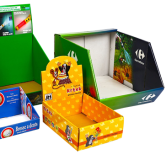



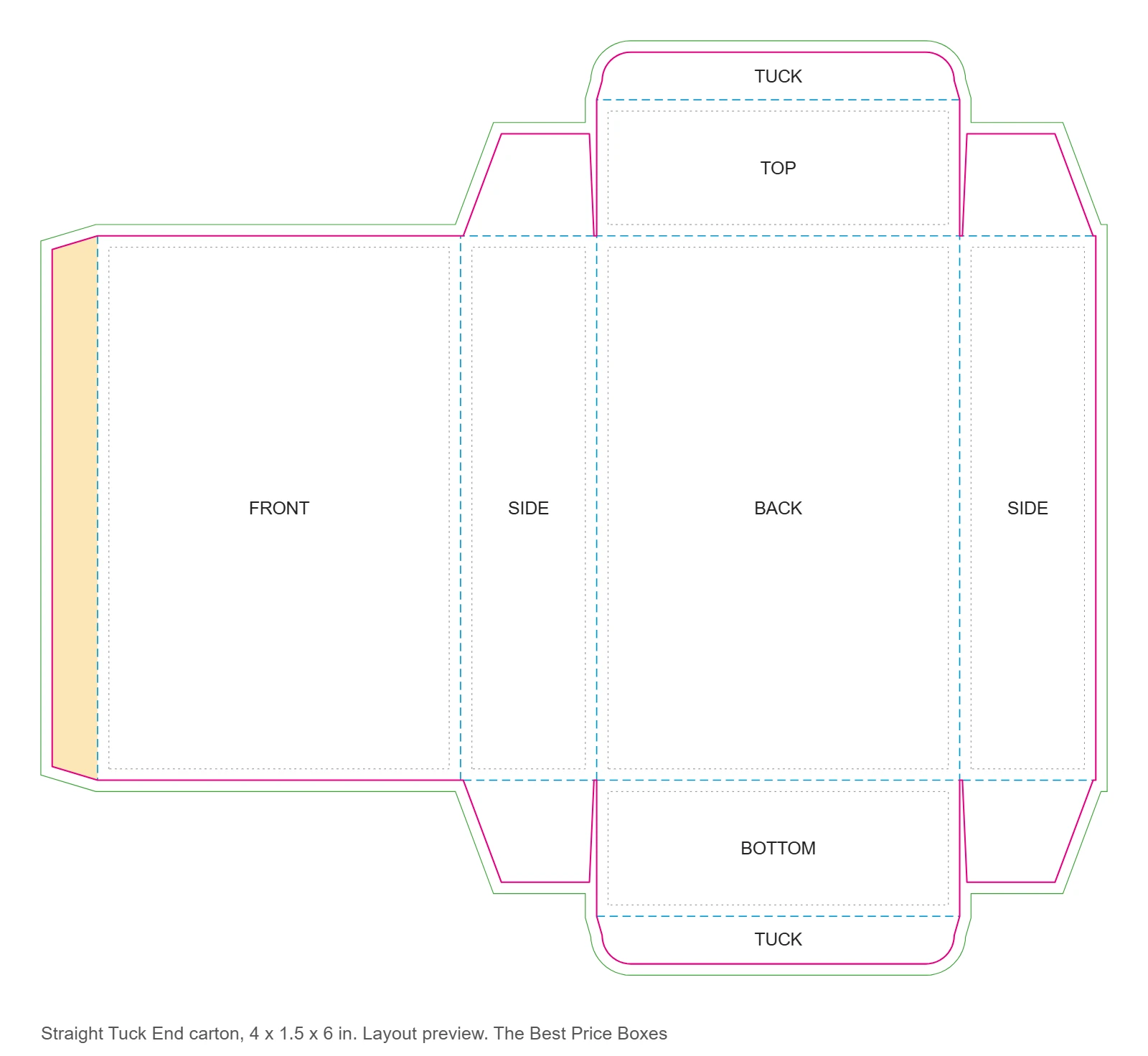
A straight tuck end dieline is a folding carton template with four side panels, a glue flap, and a tuck closure at the top and the bottom that both hinge on the back panel. Because both lids fold from the back, the front panel has no raw edge showing, which is why this style is used for cosmetics, soap, supplements and most retail cartons. This page shows the layout, five stock sizes and the artwork rules.
Send your inside dimensions and a specialist replies within one business day with a production-ready file: vector PDF that opens in Adobe Illustrator, plus SVG and DXF. Free design help, free samples and no minimum order.
Request this dieline
Stock sizes
| Inside size | Flat size, inches | Flat size, mm |
|---|---|---|
| 1.5 x 1.5 x 4 in | 6.50 x 8.05 | 165 x 204 |
| 2 x 2 x 4 in | 8.62 x 9.40 | 219 x 239 |
| 3 x 3 x 3.5 in | 12.62 x 11.50 | 321 x 292 |
| 4 x 1.5 x 6 in | 11.50 x 10.05 | 292 x 255 |
| 5 x 2 x 7 in | 14.62 x 12.40 | 371 x 315 |
Sizes are inside dimensions, length x width x depth. Flat sizes are nominal, before the allowance for board thickness. The production file we send is adjusted for your board.
How to read the layout
| Line | Meaning | What to do with it |
|---|---|---|
| Solid magenta | Cut | The knife follows this line. Nothing outside it survives. |
| Dashed blue | Crease | The board folds here. Keep small text and fine lines off it. |
| Thin green | Bleed, drawn 0.125 in outside the cut on this template | Run backgrounds and images out to this line so no white edge shows after cutting. |
| Dotted gray | Safe zone, drawn 0.125 in inside each panel on this template | Keep logos, text and barcodes inside it. |
| Orange fill | Glue area | Leave it free of ink and coating so the glue bonds to bare board. |
Setting up artwork on the dieline
- Open the file in your design program and lock the dieline on its own layer.
- Build artwork on a separate layer underneath. Work in CMYK, with any spot colors named.
- Extend backgrounds to the bleed line and keep live text inside the safe zone.
- Check which way each panel reads once folded. Lids and bottom panels often need turning 180 degrees.
- Outline fonts, embed images at 300 dpi or better, and export a vector PDF with the dieline layer still in place.
The print-ready artwork guide covers each step in more detail, and what a dieline is explains the parts of the template.
How the carton goes together
The glue flap closes the four panels into a sleeve at the factory, and the carton ships flat. To fill it, fold in the two dust flaps, fold the lid panel over them and push the tuck flap down inside the front panel. The bottom closes the same way.
Straight tuck or reverse tuck
On a reverse tuck end carton the bottom closure hinges on the front panel instead of the back. Reverse tuck nests tighter on the press sheet, so it can use less board. Straight tuck keeps both cut edges at the back, which looks cleaner on a shelf. The straight vs reverse tuck comparison goes through the trade-off.
Board
Tuck end cartons are cut from folding carton paperboard. Lighter board suits small cosmetic cartons, and heavier board suits taller or heavier products. For glass jars and bottles, an auto-lock bottom carries weight better than a tuck.
Boxes that use this structure
- Custom tuck end boxes
- Custom soap boxes
- Cosmetic cardboard boxes
- Custom cosmetic boxes
- Straight vs reverse tuck end
Back to all dieline templates.
Dieline questions
Can I resize the dieline myself?
It is better not to. Scaling a dieline also scales the glue flap, tuck depth and relief cuts, and those should stay fixed. Tell us the inside size you need and we redraw the template to it at no charge.
What bleed and safe zone should I use?
This template is drawn with 0.125 inch of bleed past the cut line and a 0.125 inch safe zone inside it, a common starting point. Keep text and logos away from every crease, and check your free digital proof, which confirms the bleed and safe zone for your job before anything prints.
Which file formats do you send?
A vector PDF that opens in Adobe Illustrator, plus SVG and DXF. The DXF keeps cut and crease lines on separate layers for CAD tables and sample cutters.
How do I work out the size I need?
Measure the product, add clearance, and give us inside dimensions as length x width x depth. The box measuring guide shows where each dimension is taken.
Send your inside dimensions and a specialist replies within one business day with a production-ready file: vector PDF that opens in Adobe Illustrator, plus SVG and DXF. Free design help, free samples and no minimum order.
Request this dieline