









Ready to order foam inserts? Get your free quote in minutes.
Free design and dielines, free samples, no minimum order, and we will beat any written quote from a competitor. Fast turnaround, made to your exact cavity layout.
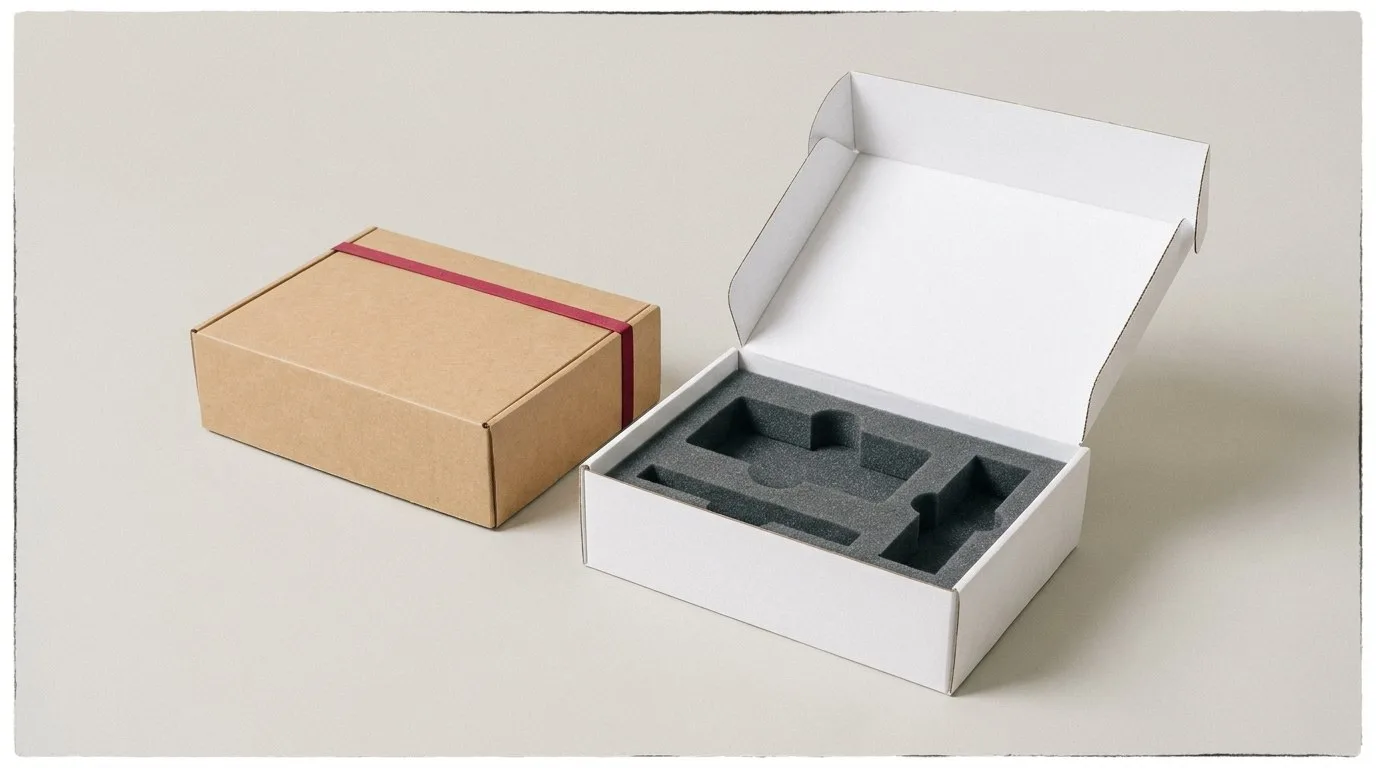
A custom foam insert is a die-cut or CNC-routed piece of foam shaped to hold one product, or a set of products, in a fixed position inside a box or case. It is the right choice when a product is heavy, has sharp corners, includes glass or electronics, or has to survive repeated drops during transit or repeated opening in the field. For lighter goods that just need to stay put, a paper or corrugated insert does the same job at a lower cost and goes in the recycling bin; foam earns its place when the product cannot risk any movement or shock.
We cut three foam types: polyethylene, polyurethane, and EVA, and we cut them two ways: die cut for volume orders, CNC routed for short runs and prototypes. Below is how to choose both.
Foam types, compared
| Foam | Density | Best for | Notes |
|---|---|---|---|
| Polyethylene (PE) | 1.7 to 4 lb/ft3 | Electronics, tools, most retail and shipped goods | Closed-cell, moisture resistant, holds a die-cut edge cleanly, widely recyclable |
| Cross-linked PE (XLPE) | 2 to 6 lb/ft3 | Precision cavities, camera and instrument cases | Finer cell structure than standard PE, cuts more cleanly on a CNC router |
| Polyurethane (PU) | 1.2 to 2 lb/ft3 | General cushioning, packing layers | Open-cell, softer and less expensive, not ideal for a crisp cavity wall |
| EVA | 4 to 8 lb/ft3 | Tool cases, hard cases, presentation cases | Dense and durable, keeps a sharp edge under repeated use, costs more |
Die cut or CNC routed

Die cutting uses a steel rule die to stamp out every layer at once. It costs a one-time tool charge and pays for itself past a few hundred units, and it is the faster, cheaper route for any order that will repeat. CNC routing carves the cavity straight from a digital file with no tool at all, so it is the right call for a prototype, a first production run under a few hundred pieces, or a design you expect to revise. Most customers start on CNC routing to prove the fit, then move to a die once the layout is final.
Anti-static and ESD foam
Electronics, circuit boards, and anything with exposed pins or connectors need foam that will not build or discharge static. Pink anti-static polyethylene bleeds off a static charge slowly and is the standard choice for most consumer electronics. Black conductive foam dissipates charge faster and is used for sensitive components and static-critical assembly work. Both cut and cavity exactly like standard PE foam, so choosing between them is a material spec, not a design change.
Layout and finish
Foam is supplied in flat sheets or convolution (“egg crate”) sheets for a soft top layer over a shaped cavity below. Cavities are cut to the product outline with clearance built in, typically a sixteenth of an inch for a snug precision fit and up to an eighth of an inch where the product is loaded and removed by hand repeatedly. Multi-cavity trays for kits and multi-piece sets are cut in one pass, and foam is available in black, charcoal, and a small range of standard colors; it is not printed the way a box or a paper insert is.
In short
What to send us: the product dimensions or a physical sample, the case or box it goes into, how many cavities or items per tray, and whether the product is static-sensitive. What you get back: a foam type and density recommendation, a cavity layout, a CNC-routed sample to check fit, and a die-cut production quote once the layout is approved.
Foam insert questions
What foam is used for custom packaging inserts?
Mostly polyethylene: closed-cell, moisture resistant, and clean to die cut. Cross-linked polyethylene is used for finer, more precise cavities. Polyurethane is a softer, cheaper option for general cushioning, and EVA is used where the insert has to survive years of reuse in a hard case.
How are custom foam inserts cut?
Die cutting for volume orders, using a steel rule die that stamps every layer at once. CNC routing for prototypes and short runs, carving the cavity directly from a digital file with no tool cost. Most orders start on a CNC-routed sample and move to a die once the fit is confirmed.
What is the minimum order for custom foam inserts?
There is no fixed minimum. CNC-routed foam is practical at any quantity since there is no tool cost; die-cut foam becomes the better value once an order is in the hundreds of units, because the die charge is a one-time cost spread across the run.
Can foam inserts be made anti-static for electronics?
Yes. Pink anti-static polyethylene and black conductive foam both cut and cavity exactly like standard foam. Anti-static is the standard spec for consumer electronics; conductive is used for static-critical components and assembly.
Should I use foam or a paper insert?
Foam for anything heavy, sharp-cornered, glass, or electronic, and for products that get handled and reinserted repeatedly in the field. A paper or corrugated insert does the job for lighter retail goods at a lower cost and is fully recyclable.
Foam inserts are one option for holding a product still inside a box. For lighter goods, see paper inserts or the full packaging inserts range. Foam is most often specified alongside a corrugated shipping box or a hard case, and pairs with a custom packing tape seal for retail-ready presentation.
More Custom Packaging Inserts
See the full Custom Packaging Inserts range, or explore related options with no minimum order and our best-price guarantee: