
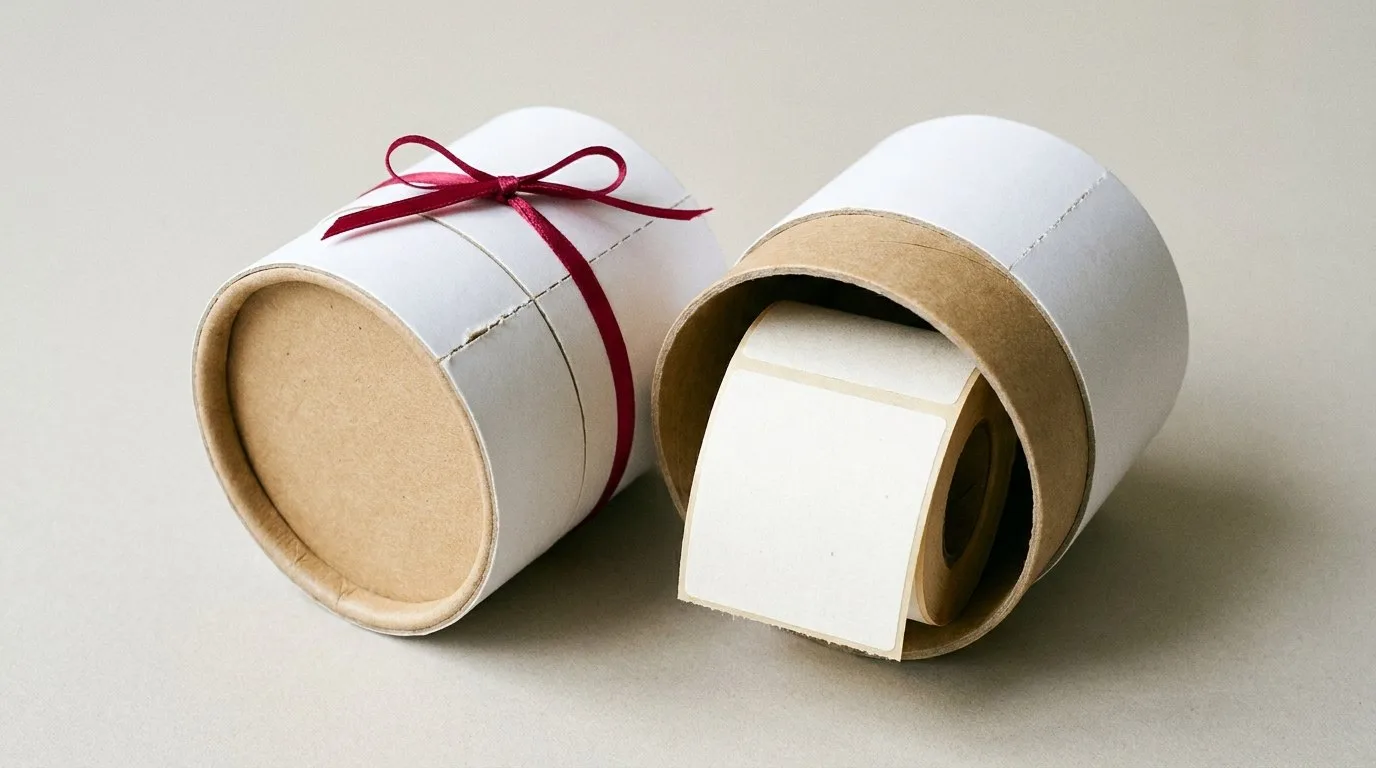


Custom roll labels are printed, die-cut labels supplied on a roll so they can be peeled off by hand or applied by a machine. TBPB prints them to your artwork with no minimum order, and if you hold a written quote for the same specs, the price-beat guarantee comes into play.
Four details that decide whether a roll works for you
People order labels by shape and artwork, then discover the roll does not suit their setup. Four details prevent that. The core is the cardboard tube in the middle, and the common sizes are 1 inch and 3 inch, with the larger core standard on applicator machines. The unwind direction says which edge of the label leaves the roll first and whether the print faces in or out, and it only matters if a machine or dispenser feeds the rolls. The roll diameter has to clear the holder it sits in. Last, the label count per roll decides how often someone stops to change it. Tell us how the labels get applied and we will set those four to match.
Choosing the face material and adhesive
Paper labels are the economical default for dry goods, shipping marks and boxes. They print well and take a matte or gloss coating, but moisture and rubbing will mark them. Film labels in polypropylene or similar plastics are stronger against water, oil and handling, so they suit bottles, tubes, jars and anything that lives in a fridge or a bathroom. Kraft-look paper gives an earthy feel that works on soap, coffee and candles. The adhesive matters just as much as the face. A permanent adhesive grips and stays. A removable one peels cleanly but can lift on cold or damp surfaces. Textured or curved surfaces usually want a stronger tack, so mention the surface when you request a quote. If you need labels rated for wet conditions, see our waterproof labels.
Shape, size and print
Rolls can be cut to a circle, square, rectangle, oval or a custom die shape. Keep the artwork inside a safe margin of about 1/8 inch from the cut line, and extend background color a little past the cut so a tiny shift on the press does not leave a white edge. Print is full color CMYK, with Pantone matches for brand colors, and a gloss or matte finish over the top. Small text and thin reversed-out lines are the usual trouble spot, so keep body copy at a readable size, around 6 point or larger, and test a proof on the actual surface. For labels that go on shipping cartons or retail packaging more generally, our custom packaging labels cover that side of the range.
When a roll is not the right format
If you only need a few dozen labels and you apply them by hand, a roll is still fine, since there is no minimum, but a sheet format may be easier to store. If labels need to wrap a whole bottle with a full-bleed design, ask about the label size and the wrap overlap before you order. You can see the wider selection in the stickers and labels category.
- Shapes: circle, square, rectangle, oval or a custom die cut
- Face stock: paper, kraft-look paper, or plastic film
- Adhesive: permanent or removable, chosen for your surface
- Core: 1 inch or 3 inch, with unwind direction to match your applicator
- Print: CMYK with Pantone matching, plus gloss or matte finish
To start, send the label size, the surface it goes on, how it is applied and the quantity, even if it is one roll. We prepare the die and quote it.
Frequently asked questions
Is there a minimum order for custom roll labels?
No. TBPB has no minimum order, so you can order one roll to test your artwork and adhesive or many rolls for full production. The setup process is the same either way: you send the size and quantity, and we prepare a die and a proof.
What core size should I choose for my label rolls?
Choose by how the rolls are used. A 1 inch core suits most desktop printers and hand dispensing. A 3 inch core is common on automatic applicators and larger rolls. If you are unsure, tell us the machine or dispenser model and we will match it.
What is unwind direction and do I need to specify it?
Unwind direction describes how the label leaves the roll, including which edge feeds first and whether the print faces outward. It only matters if a machine applies the labels. For hand application it makes no difference, so you can leave it to us.
Can roll labels be cut to a custom shape?
Yes. We can cut circles, squares, rectangles, ovals and custom die shapes. Keep artwork about 1/8 inch inside the cut line and let background color run slightly past it, so small press shifts do not leave a white edge.
Which material is best for bottles and jars?
Film labels in polypropylene or similar plastics resist moisture, oil and rubbing better than paper, so they are the safer choice for bottles, jars and tubes. Paper is fine for dry goods and boxes. Tell us the product and storage conditions for a recommendation.
Can I get a proof before the full run?
Yes. We prepare a proof from your artwork and dimensions, and with no minimum order you can also run one short roll first to test the adhesive and print on the real surface before you commit to a bigger order.
More Custom Stickers and Labels
See the full Custom Stickers and Labels range, or explore related options with no minimum order and our best-price guarantee: