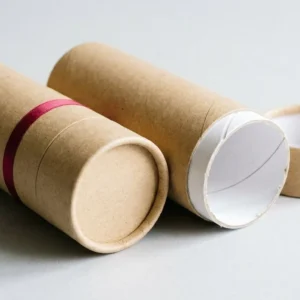


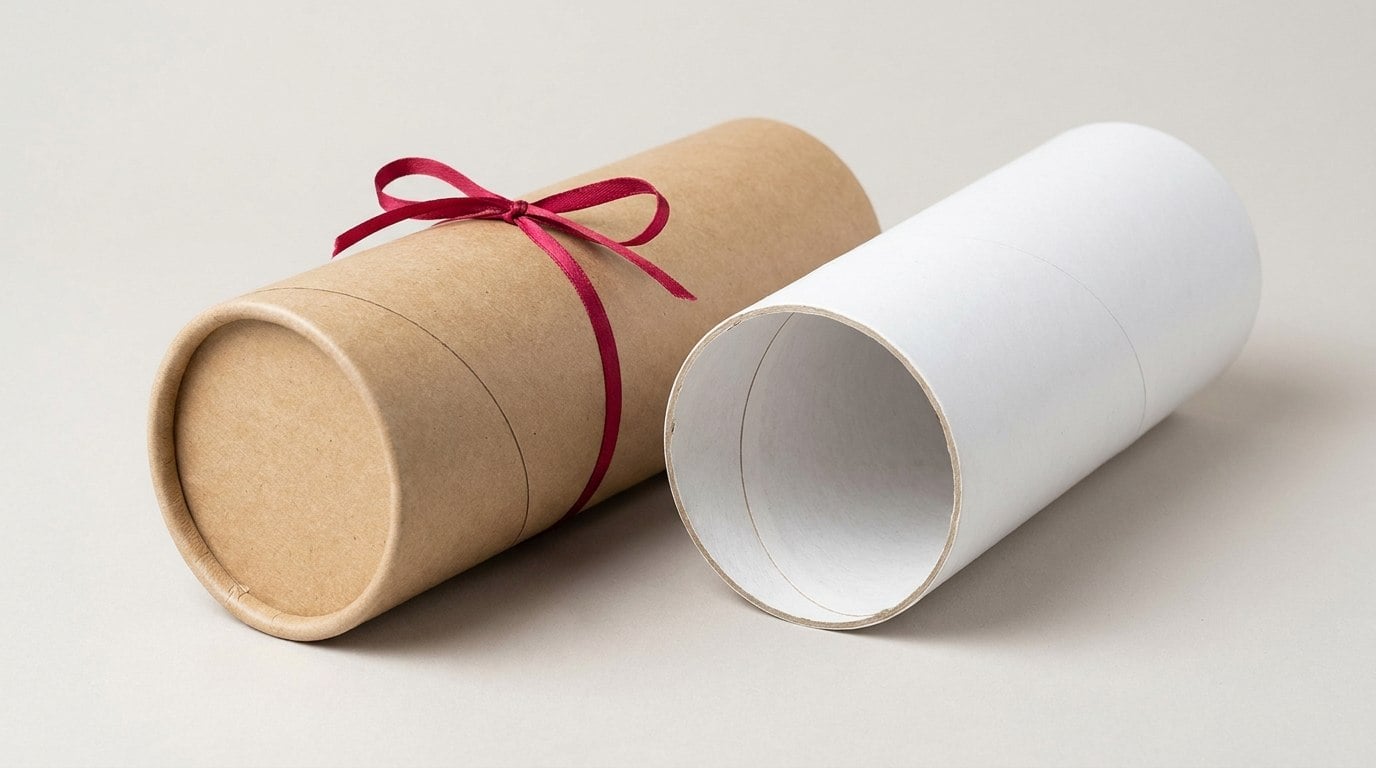


A custom mailing tube is a rigid paper cylinder with a cap fitted on each end, built to carry rolled items such as posters, art prints, architectural drawings, calendars and fabric through the mail without a crease. TBPB makes them to your diameter and length, printed with your branding, with no minimum order, and we will beat a written quote on matching specs.
How a mailing tube is built and what that means for protection
The body is made by winding layers of paper around a mandrel and gluing them into a spiral. The more plies and the thicker the wall, the better the tube resists crushing and the less it flexes when a carrier drops it. End caps are the other half of the equation. Plastic plug caps push into the open ends and grip the inside wall. Metal end caps fit over or into the end and give a firmer, more industrial feel, which suits heavier contents or shipments that are going to get handled hard.
A tube protects well against bending and crushing from the sides. It does less against impacts on the ends, which is why long, valuable items such as framed-quality prints should be wrapped in tissue or glassine before they go in.
Getting diameter and length right
Roll the product the way it will actually ship and measure the roll diameter, not the flat width. Poster stock is stiffer than most people expect, so a loose roll can be wider than you planned. Add some clearance so the item slides in without scraping, but not so much that it can knock around. For length, the tube must be at least as long as the flat width of the item plus a small allowance for the end caps. If you are shipping several rolled items together, test the combined roll.
When a customer will unroll the contents and frame them, a larger diameter keeps the curl gentle. Tight rolls in a narrow tube can leave a memory curve in heavier paper that takes weeks to flatten.
Printing and finish options
- Printed wrap in full colour, applied over the tube body
- Kraft or white outer surface, depending on how bright you want the artwork
- Custom lengths and diameters to match your product, no standard size forced on you
- Plastic or metal end caps in the colour range available for your quantity
- Matte or gloss coating on the printed wrap
Print on a curved surface behaves differently from a flat box panel. Fine detail and small text near the seam can distort slightly, so keep critical logos away from the overlap line and ask for a proof before you approve the run.
When a tube is the wrong choice
Tubes are cylinders, so they do not stack or pack as tightly as boxes, and a rolled item will not suit a customer who wants it flat. If you ship framed art, canvas on stretcher bars or anything that must stay flat, a corrugated carton or a custom mailer box is safer. If you sell cosmetics, deodorant or retail goods, look at our paper tube packaging and tube packaging pages, which are made for shelf presentation rather than shipping. The full custom tube packaging range shows every option.
Next step
Send us the item you want to roll, its flat width and the number of pieces per tube. We will recommend a diameter and length, draw up the print layout and quote it, whether you need one tube or a pallet. If the contents are heavy or the shipment will travel a long way, mention that too, because it changes the wall and end cap we would suggest.
Frequently asked questions
Is there a minimum order for custom mailing tubes?
No. TBPB has no minimum order on mailing tubes. Order one to test how your poster or print rolls and ships, or order a full run once you are happy. Send diameter, length and artwork and we quote exactly what you need.
What size mailing tube do I need for a poster?
The tube length must be at least as long as the poster width. For diameter, roll the poster as it will ship and measure the roll, then allow a little clearance so it slides in freely. Heavy poster stock rolls wider than thin paper, so test with the real item.
Plastic or metal end caps, which is better?
Plastic plug caps are light and grip the inside of the tube, which suits most prints and documents. Metal caps feel firmer and handle rougher shipping better, so they suit heavier contents. If you are unsure, tell us what is going inside and how it will travel.
Can mailing tubes be printed with my logo?
Yes. We print a full-colour wrap on the tube body from your supplied artwork. Keep important logos away from the seam where the wrap overlaps, because print across a seam can shift slightly. We can share a proof before the run starts.
Are mailing tubes waterproof?
No. A paper tube resists crushing, but it is not waterproof, and a long soak will soften the wall. If your shipment may meet rain or damp, wrap the contents in a plastic sleeve or poly bag inside the tube, or ask us about alternatives.
How do I stop a poster getting dented in a tube?
Wrap it loosely in tissue or glassine, roll it with the image facing outward, and make sure it fits without being forced in. Dents mostly come from rolls that are too tight or too loose. A tube that is only slightly wider than the roll is the safest fit.
More Custom Tube Packaging
See the full Custom Tube Packaging range, or explore related options with no minimum order and our best-price guarantee: