



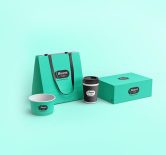


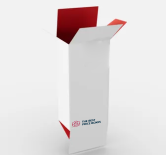

Rigid boxes are the thick, non-folding boxes used for premium packaging. The body is cut from greyboard, usually somewhere between 1.2mm and 3mm thick, then wrapped in printed paper. They arrive assembled rather than flat, which is why they feel solid and why they cost more to ship. We make them with no minimum order, so you can run fifty and not five thousand, and we will beat any written quote you already have.
What actually makes a box rigid
A folding carton is one printed sheet, scored and glued, that folds flat. A rigid box is different. A chipboard or greyboard frame is cut and formed first, then a separate printed wrap is glued over it. That two-part construction is the whole reason rigid feels the way it does, and the whole reason it is priced the way it is.
Board thickness is the number that matters most. Around 1.2mm gives a light gift box. Around 2mm is the common middle ground for cosmetics and spirits. At 3mm you get the heavy, furniture-like feel used for watches and high-end electronics. Thicker board means more material, a bigger outside dimension for the same inside dimension, and more cost per unit.
The styles worth knowing
Two piece, lid and base. The classic shirt-box format. A separate lid lifts off a base. Simple, strong, and the cheapest rigid style to produce because there are no moving parts.
Magnetic closure. A hinged lid with magnets concealed under the wrap. This is the format most people picture when they think premium unboxing. The magnets add cost per unit and a little assembly time.
Book style. Opens on a spine like a hardback. Good for sets, stationery and anything you want displayed face up on a shelf.
Drawer or slide. An inner tray slides out of an outer sleeve. Popular for jewelry and small electronics because the reveal is slow and deliberate.
Neck and shoulder. An internal collar sits between base and lid, creating a stepped border when closed. This is the construction behind most premium spirits and fragrance packaging.
Collapsible. Ships flat and is assembled by hand at your end. Costs more per unit to make, saves a great deal on freight and warehouse space. Worth it when volumes are high or storage is tight.
Wrap, print and finish
The wrap is where the brand lives. Coated art paper takes photographic print and is the default. Uncoated and textured stocks feel better in the hand but shift color, so ask for a physical proof before committing. Speciality papers such as linen, felt and leatherette are wrapped rather than printed, which means your logo goes on by foil stamping, embossing or screen print instead of full color.
Common finishes are matte or gloss lamination, soft touch lamination, foil stamping, embossing, debossing and spot UV. Soft touch on a dark wrap shows fingerprints, which is worth knowing before you order a thousand black boxes.
When rigid is worth the money, and when it is not
Rigid earns its cost when the box is part of the product experience: gifting, luxury, subscription reveals, anything a customer keeps or photographs. It also protects better, so it makes sense for fragile items even when the brand is not premium.
It is the wrong choice when the box is purely a transport container, when you are shipping high volumes where the cubic freight cost will dominate, or when the retail price cannot absorb it. A well-printed folding carton with a good finish often reads as more premium than a cheap rigid box, and costs less.
What drives the price
Four things move rigid box pricing more than anything else. Board thickness, because it is raw material. Assembly, because rigid boxes are largely hand-finished rather than machine-run. Inserts, since a foam or molded fitting can cost as much as the box. And volume, because setup is spread across the run.
Rigid is also volumetric to ship. An assembled box is mostly air, so freight is charged on the space it occupies rather than its weight. If you are ordering in quantity, ask what the collapsible version does to your landed cost before you decide.
Lead times, honestly
Rigid takes longer than folding carton because of the hand assembly step. Plan for a proof first, then production. If you have a fixed launch date, work backwards from it and give yourself margin, because rigid is not the product to rush. We will give you a real date rather than an optimistic one.
Ordering rigid boxes with no minimum
Most manufacturers set a floor on rigid, often several hundred units, because the setup and hand assembly are hard to justify on a short run. We do not. You can order a small run to test a design, then scale once it sells. The per-unit price is higher on a short run, which is simply how manufacturing works, but there is no minimum and no minimum-order fee.
Send us a competing written quote and we will beat it. If you are not sure which style or board thickness fits your product, tell us what you are packing and we will spec it for you.
Ready to price a job? See custom rigid boxes with no minimum order, or browse the full custom rigid boxes range by style.
The five styles, and where to order each one
Each style below has its own page with its own spec, not a filter on a catalogue. If you already know the shape you want, go straight to it.
- Magnetic closure rigid boxes for a lid that snaps shut on its own.
- Two piece rigid boxes, the base and lid set most gift packaging uses.
- Collapsible rigid boxes when you want the rigid feel but need to ship flat.
- Drawer rigid boxes for a sleeve and tray that slides open.
- Book style rigid boxes with a hinged lid that opens like a cover.
Still deciding between rigid and something cheaper? Read rigid boxes versus folding cartons or mailer boxes versus rigid boxes. If the question is what it will cost, we wrote how much custom rigid boxes cost.
Rigid boxes FAQ
Is there a minimum order for custom rigid boxes?
Not at The Best Price Boxes. We produce custom rigid boxes with no minimum order quantity, so you can order a small sample batch or a full production run using the same pricing logic.
What’s the difference between rigid boxes and folding cartons?
Folding cartons are thin, foldable paperboard that ships flat and gets assembled on demand. Rigid boxes use a thick chipboard core wrapped in decorative paper, arrive pre-assembled, and hold their shape permanently. Rigid boxes cost more but give a premium, substantial feel that folding cartons can’t match.
What chipboard thickness should I choose?
1.5mm works for lightweight items like jewelry or cosmetics. 2mm is the standard mid-weight choice for most retail and gift boxes. 3mm or higher suits heavier products or boxes that need to survive repeated handling, like electronics packaging.
Can I get a sample before ordering in bulk?
Yes, since there’s no minimum order quantity, a small sample run of 10 to 25 boxes in your actual chipboard thickness, wrap material, and print is a normal first order. Most customers test a sample before committing to full production.
What’s the difference between two-piece and collapsible rigid boxes?
A two-piece box has a separate lid and base, simpler to make, lower cost, but ships fully assembled and takes up more space in transit. A collapsible box folds flat with a magnetic or friction closure, so it ships and stores compactly, then pops into shape for use. Collapsible costs more per unit but cuts warehousing and shipping volume.