







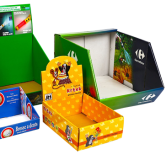


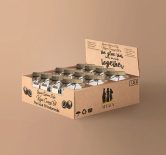
A box size calculator turns your product measurements into the two numbers a packaging manufacturer actually needs: inside dimensions and outside dimensions. Inside is what has to fit your product. Outside is what the carrier bills you for. Get those two right and everything after them, the board grade, the die line, the freight cost, falls into place. This tool does the arithmetic, including the wall thickness most people forget.
Work out your box size
Measure the product itself, not the box you have now. Enter the largest point in each direction.
How to measure your product
Measure the product, not the box you are using now. If you copy your current box you inherit whatever mistake is already in it. Take the widest point in each direction, including handles, lids, caps and anything that sticks out. Round up to the nearest sixteenth of an inch rather than down.
Length is the longest side of the opening. Width is the shorter side of the opening. Height, sometimes called depth, is the distance from the bottom of the box to the top. Manufacturers read dimensions in that order, so a 6 x 4 x 3 box is not the same as a 4 x 6 x 3 box on a die line even though the volume matches.
How much room to leave around the product
This is where most first orders go wrong. Too tight and the product will not seat, or the box bulges and the print distorts on the corners. Too loose and the product rattles, the box crushes in transit, and you pay for air.
| What goes in with the product | Room to add across each axis |
|---|---|
| Nothing, the product sits in bare | about 1/8 in |
| Tissue, a thin liner, a label wrap | about 1/4 in |
| Loose fill, a bubble layer, a printed sleeve | about 1/2 in |
| Foam or a moulded insert | twice the insert thickness |
Those are starting points, not laws. A ceramic mug wants more room than a folded t shirt of the same size, because one of them survives a drop and one does not.
Inside dimensions are not outside dimensions
Every wall has thickness, and it shows up twice on each axis. On a B flute mailer that is roughly a quarter of an inch added to length, width and height once both walls are counted. On a double wall shipper it is closer to half an inch. On a rigid gift box with wrapped greyboard, the walls are thinner than people expect but the lid adds height.
| Construction | Typical wall thickness | Where it earns its place |
|---|---|---|
| E flute corrugated | about 1/16 in (1.6 mm) | printed mailers, retail ready boxes, crisp print surface |
| B flute corrugated | about 1/8 in (3.2 mm) | the default ecommerce mailer, good crush resistance |
| C flute corrugated | about 5/32 in (4 mm) | shippers with heavier or bulkier contents |
| BC double wall | about 1/4 in (6.4 mm) | heavy contents, stacked pallets, long transit |
| Rigid, wrapped greyboard | about 2 mm per wall | luxury, gifting, anything sold on the unboxing |
| Cardstock folding carton | about 20 pt (0.02 in) | retail shelf, cosmetics, light products |
Why an inch matters more than a pound
Carriers bill the greater of actual weight and dimensional weight, and dimensional weight is pure geometry. Multiply the outside length, width and height, then divide by the carrier divisor. The calculator above shows the result at a 139 divisor because that is the figure most US small parcel accounts quote, but divisors vary by carrier, service and contract, so check the number on your own rate sheet before you budget from it.
The practical takeaway is blunt. If your box is bigger than it needs to be, you pay for that empty space on every single parcel, forever. Taking one inch off each side of a 12 x 10 x 8 box drops the dimensional weight from about 6.9 lb to about 5.0 lb. On a few thousand parcels a year that is a real number, and it costs nothing but a better die line.
A worked example
Say you sell a candle in a 3.5 in diameter jar, 4 in tall, and you want it to arrive with a printed insert. Product footprint is 3.5 x 3.5 x 4. Add 1/2 in across each axis for the insert and you need an inside size of 4 x 4 x 4.5. Build it in B flute and the outside lands near 4.25 x 4.25 x 4.75. That is a small, cheap parcel that presents well, and it is a completely different cost to the 6 x 6 x 6 stock box most new brands reach for.
What to do with the numbers
Send us the inside dimensions and the construction. We will confirm the die line, tell you honestly if a different flute or style would be cheaper for what you are shipping, and put a price on it. There is no minimum order, so you can run one to check the artwork before you commit to a thousand, and you get a free digital proof before anything prints. Typical production runs about 10 to 14 business days once the proof is approved, with rush available when a launch date is fixed. If you already hold a written quote from somewhere else, send it over and we will beat it.
Related reading: what custom boxes actually cost, the corrugated board guide, and the mailer box guide. Ready to buy: custom shipping boxes, mailer boxes and rigid boxes.
Box size calculator questions
Should I give you inside or outside dimensions?
Inside, every time, unless you are matching an existing shipper you must fit inside. Inside dimensions describe what has to fit. We work the outside from the board you choose, so if you hand over an outside measurement by mistake the finished box comes out a little small.
How much space should I leave around my product?
About 1/8 in across each axis if the product goes in bare, about 1/4 in with tissue or a liner, about 1/2 in if there is loose fill or a sleeve. With foam or a moulded insert, add twice the insert thickness. Fragile items want the upper end of the range.
Why is my shipping cost higher than the weight suggests?
Because carriers bill the greater of actual weight and dimensional weight. Dimensional weight is the outside volume divided by a divisor set by your carrier and service. A light product in an oversized box gets billed on the box, not the product, which is why right sizing usually pays for the tooling within a few hundred parcels.
Do you have a minimum order?
No. You can order one box to check the artwork, the fit and the print, then scale up when you are happy. That is unusual in custom packaging, where minimums of 100 to 500 units are normal and some suppliers will not quote below a thousand.
Can you make a box to an exact size?
Yes. Everything is made to your die line rather than pulled from a stock size ladder, so if you need 4.375 x 4.375 x 4.75 that is what gets made. Odd sizes do not cost more than round ones.