








This page exists because we could not find a mylar barrier reference that named its sources. Most supplier pages say a bag is a great oxygen and moisture barrier and stop there. That is not a specification, and you cannot design a shelf life around it.
Everything below is either a definition, a conversion you can check yourself, or a figure we have attributed. Where we could not verify something we have said so rather than fill the gap.
The two numbers that matter
Barrier is described by two transmission rates. Both measure what gets through a given area in a given time, so in both cases a lower number is a better barrier.
OTR, oxygen transmission rate. How much oxygen passes through. Quoted as cc per square metre per 24 hours in metric, or cc per 100 square inches per 24 hours in US units. Normally tested at 23 degrees Celsius and 0 percent relative humidity.
MVTR, moisture vapour transmission rate. Sometimes written WVTR. How much water vapour passes through. Quoted in grams per square metre per 24 hours, or grams per 100 square inches per 24 hours. Normally tested at 37.8 degrees Celsius and 90 percent relative humidity.
The test conditions are part of the number. A moisture figure measured at 90 percent humidity and one measured at 50 percent are not comparable, so a barrier figure quoted with no conditions attached is not usable. Ask for the conditions.
Converting between the two unit systems
100 square inches is 0.0645 square metres, so:
| To convert | Multiply by |
|---|---|
| cc per 100 square inches per day, into cc per square metre per day | 15.5 |
| cc per square metre per day, into cc per 100 square inches per day | 0.0645 |
| grams per 100 square inches per day, into grams per square metre per day | 15.5 |
| grams per square metre per day, into grams per 100 square inches per day | 0.0645 |
This catches people out constantly. A film quoted at 1 and a film quoted at 15.5 can be the same film described in different units.
What counts as high barrier
The line the industry generally draws for oxygen is below 1 cc per 100 square inches per 24 hours, which is about 15.5 cc per square metre per 24 hours. Below that a structure is described as high barrier.
It is a convention, not a standard. Nobody publishes it as a rule, and a number that qualifies as high barrier for a snack food may be nowhere near good enough for something that oxidises quickly. Treat it as a floor to clear, not a target to aim at.
Typical published values
These are figures published by film suppliers for the two structures used in most mylar pouches. They describe the film, not any particular finished bag.
| Structure | OTR, cc per square metre per day | MVTR, grams per square metre per day |
|---|---|---|
| Metallised polyester, VMPET, unflexed | about 1.2 | about 0.8 |
| Aluminium foil laminate, undamaged | effectively zero | effectively zero |
Unverified. We have not been able to source figures we would stand behind for ceramic coated PET, EVOH or PVDC coated structures. Several suppliers publish comparison charts as images with no test conditions attached, which is not something we are willing to copy across. If you need those, ask and we will get them from the film supplier for the specific grade.
Foil is the better barrier and it is not always the better bag
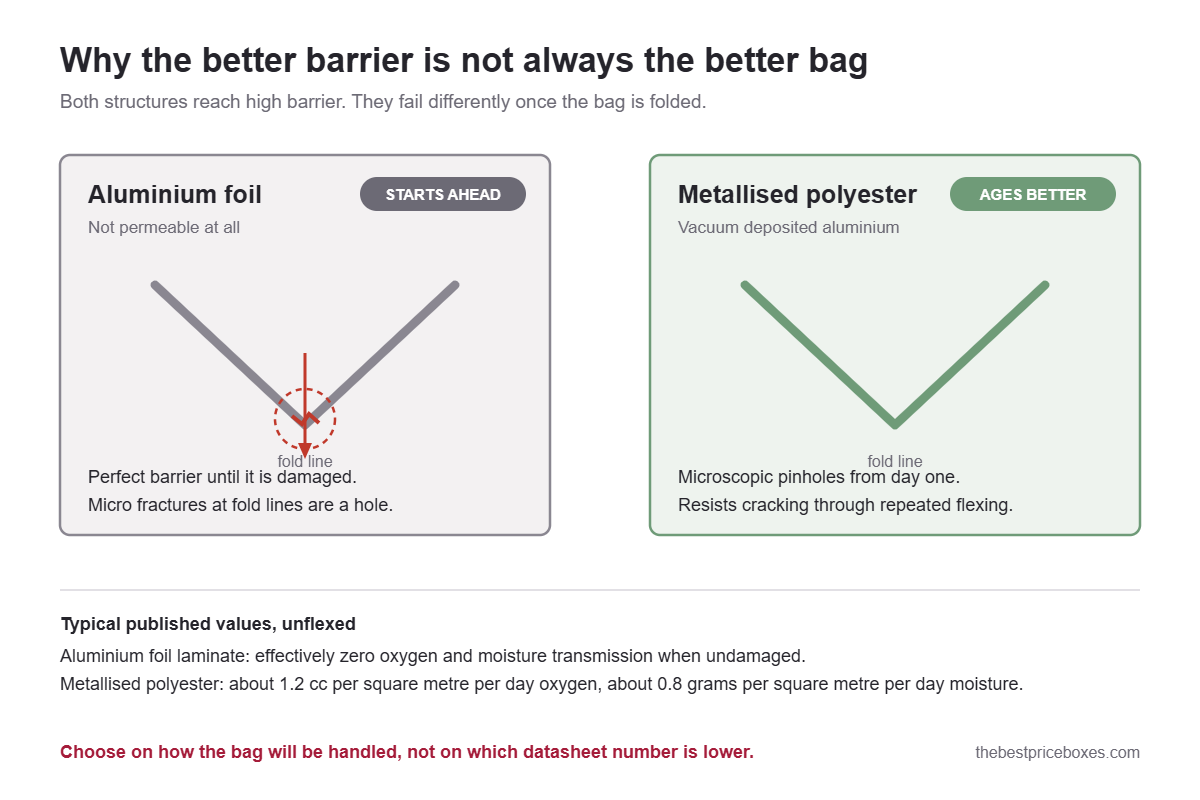
Aluminium foil is not permeable. Oxygen does not diffuse through metal, so a perfect foil laminate has no transmission rate worth quoting. Metallised polyester is a very thin layer of aluminium vapour deposited onto film, and that process leaves microscopic pinholes, which is why its figures start slightly worse.
Then the bag gets handled. Foil can develop micro fractures at fold lines and under repeated flexing, and a crack in a foil layer is a hole straight through the barrier. Metallised polyester resists that flexing far better. It starts behind and it degrades more gracefully.
So the question is not which structure has the better number on a datasheet. It is which one still has its barrier after your product has been folded into a mailer, carried in a pocket, or opened and resealed twenty times.
A rough rule that holds up: foil for things that sit still and need the absolute barrier, metallised polyester for things that get handled.
What each layer in the laminate does
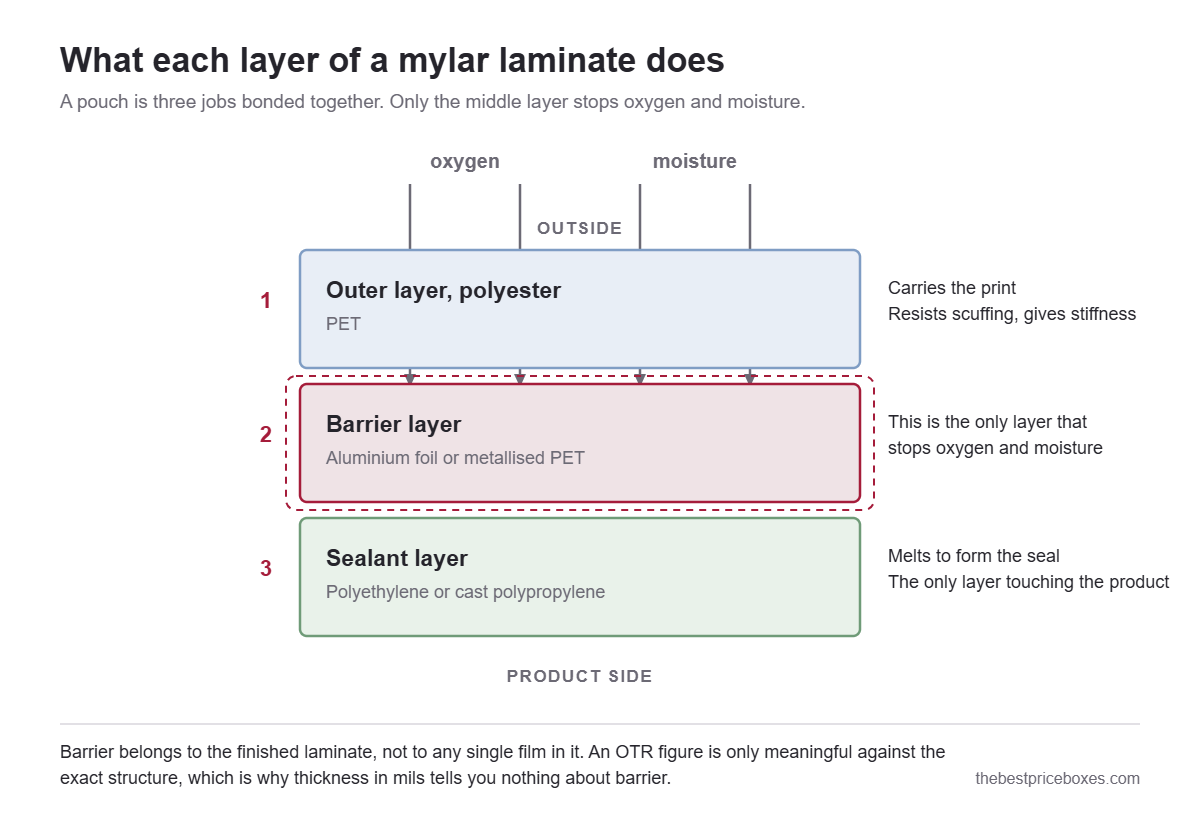
A mylar pouch is a laminate, and the layers do different jobs.
The outer layer is usually polyester. It takes the print, resists scuffing and gives the bag its stiffness.
The middle layer does the barrier work. This is the foil, the metallised film, or a coated or co extruded barrier such as EVOH, ceramic coated PET or PVDC coated PET.
The inner layer is a sealant, normally polyethylene or cast polypropylene. It melts to form the seal and it is the only layer that touches the product.
Barrier belongs to the finished laminate rather than to any single film in it. That is why a barrier figure for a bag is only meaningful against the exact structure, and why we will not quote one until we know what we are proposing.
Thickness, and why it is not barrier
Film thickness is quoted in mils, microns or gauge, and all three describe the same thing.
| Unit | Equals |
|---|---|
| 1 mil | One thousandth of an inch, 25.4 microns, 100 gauge |
| 1 micron | 0.03937 mil, 0.001 millimetres |
| 100 gauge | 1 mil, 25.4 microns |
| 3 mil | 76.2 microns |
| 4 mil | 101.6 microns |
| 5 mil | 127 microns |
Thickness describes the whole wall, not the barrier layer inside it. A 5 mil bag with a poor structure will let more oxygen through than a 3 mil bag with a good one. Thickness buys puncture resistance, stiffness and a feeling of quality in the hand. It does not buy barrier.
This is the single most common specification error we see. People ask for a thicker bag when what they actually need is a better barrier layer.
Bag size by capacity
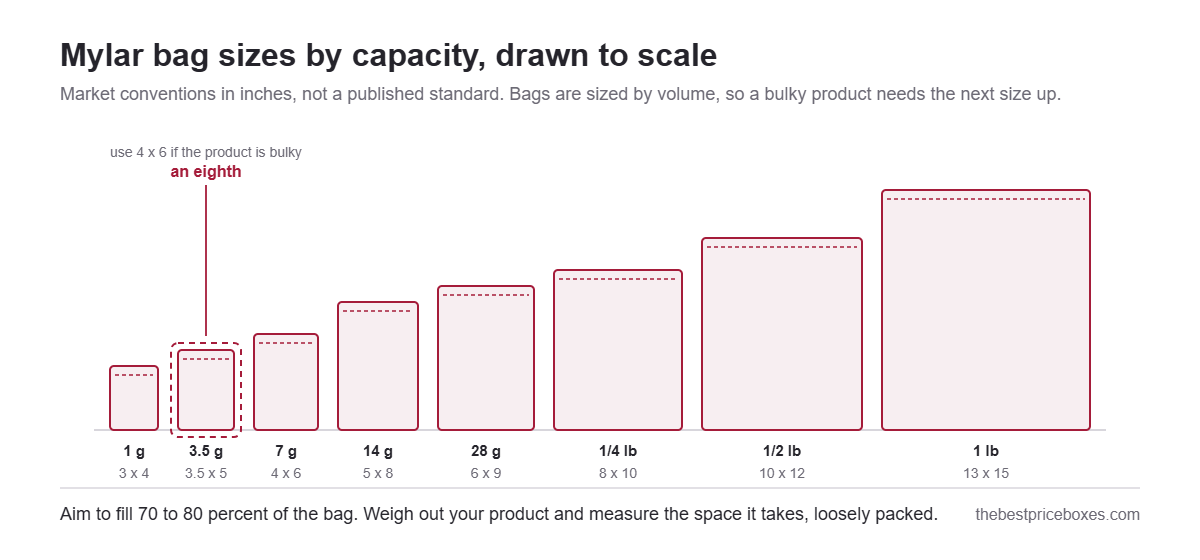
The sizes the market has converged on, for reference. These are conventions rather than a published standard.
| Capacity | Bag size, inches |
|---|---|
| 1 g | 3 x 4 |
| 3.5 g, an eighth | 3.5 x 5 |
| 7 g, a quarter | 4 x 6 |
| 14 g, a half | 5 x 8 |
| 28 g, an ounce | 6 x 9 |
| Quarter pound | 8 x 10 |
| Half pound | 10 x 12 |
| One pound | 13 x 15 |
Bags are sized by volume and products are sold by weight, so these only work when your product has an ordinary density. Aim to fill 70 to 80 percent of the bag. There is more on that on our 3.5 gram mylar bag page.
What to ask a supplier for
Five questions that separate a real specification from a sales sheet.
What is the full structure? Layer by layer, outer to sealant, with the barrier layer named.
What are the OTR and MVTR for that structure, and at what test conditions? A figure without conditions is not a figure.
Is the barrier foil or metallised? This determines how the bag behaves after handling, not just on day one.
What is the total thickness, and in which unit? Mils and microns get confused constantly.
If the closure needs to be child resistant, what standard was it tested against? The references are 16 CFR Part 1700 and ASTM D3475, and certification belongs to the finished package rather than the film. Ask for the letter.
What we could not verify
Published OTR and MVTR values for ceramic coated PET, EVOH and PVDC coated structures. The comparison charts we found were images without test conditions.
Any single authoritative source for the bag size ladder above. Multiple suppliers agree on it, which is why we publish it, but it is a market convention and no standards body defines it.
Whether the high barrier threshold of 1 cc per 100 square inches per day originates in a specific standard. It is used consistently across the industry and we have not found its source.
If you can point us at a primary source for any of these we will update the page and say where it came from.