







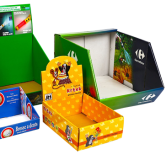


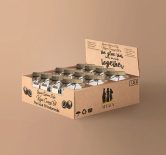
Yes, The Best Price Boxes makes custom donut boxes with no minimum order, and we will beat any written quote you already have. A donut box is a food grade paperboard carton sized by the grid the donuts sit in, not by a catalogue size, and its two real jobs are resisting grease from the underside and letting steam out before it turns the glaze to syrup.
Custom donut box specs
| Spec | What you get |
|---|---|
| Minimum order | None. Print a single count to test it, or your whole range at once. |
| Construction | One piece auto lock bottom with a tuck top, the classic bakery build. Two piece lid and base and 1 2 3 snap lock bottoms are also available. |
| Board | Food grade SBS, typically 16 to 24 pt, or kraft. Corrugated E flute for large counts and for anything travelling any distance. |
| Food contact | Board and inks suitable for direct food contact, made from components cleared for paper and paperboard under the FDA indirect food additive rules. |
| Grease resistance | Grease resistant board or a clay coated surface. We can supply without intentionally added PFAS, which several states now require. |
| Windows | Die cut window with a food safe clear film patch, or an open die cut with no film for a vented look. |
| Venting | Small die cut vents in the lid or side wall to release steam and stop the glaze weeping. |
| Counts | Single, 2, 4, 6, 12 and 24. Inserts available to hold the grid steady. |
| Printing | Full color CMYK, Pantone spot colors, white ink on kraft. Inside printing available. |
| Finishes | Aqueous coating for food surfaces. Lamination and foil for the outside only. |
| Design | Free. Dielines, mockups and revisions included. |
| Samples | Free. |
| Shipping | Free. |
How to size a donut box properly
There is no universal donut box size, because there is no universal donut. Rather than copy a size off a catalogue and hope, do the arithmetic from the product you actually sell.
A standard raised yeast donut runs close to 3.5 inches across. A cake donut is usually a little smaller, around 3.25 inches. Filled and specialty donuts vary the most and are often oval rather than round.
Lay them out in the grid you want and add clearance. Six donuts in a two by three grid at 3.5 inches each needs about 7 by 10.5 inches of product, so an interior around 7.5 by 11 inches gives you room to lift them out without tearing the glaze. Twelve in a three by four grid needs about 10.5 by 14 inches of product, so an interior near 11 by 14.5 inches. Depth is where people over specify. A single layer of standard donuts only needs about 2 to 2.5 inches. Tall filled donuts, or anything with a piled topping, want 3.5 to 4 inches so nothing touches the lid.
| Count | Grid | Interior footprint, approximate | Interior depth |
|---|---|---|---|
| 1 | Single | Around 4 by 4 inches | 2 to 3.5 inches |
| 4 | 2 by 2 | Around 7.5 by 7.5 inches | 2 to 3.5 inches |
| 6 | 2 by 3 | Around 7.5 by 11 inches | 2 to 3.5 inches |
| 12 | 3 by 4 | Around 11 by 14.5 inches | 2 to 4 inches |
| 24 | 4 by 6, or 12 in two layers with a tray | Around 14.5 by 21 inches | 4 inches and up |
Measure your own donuts before you commit. A shop selling oversized specialty donuts can be an inch out on every dimension against these numbers, which is exactly why we send free samples.
Grease is the problem nobody plans for
Donuts are fried. Whatever oil is left in them migrates into the board from the moment they are boxed, and on an uncoated stock a dark ring appears within the hour. It looks cheap, it weakens the base, and if the box has been carried it can transfer onto a customer’s clothing.
Two things fix it. A grease resistant board, where the barrier is built into the sheet, or a clay coated surface on the inside face. Either works. What matters is that you specify one of them, because plain uncoated kraft will not hold back frying oil, however good it looks.
There is a second consideration here that has changed recently. Grease resistance in paper packaging was historically achieved with per and polyfluoroalkyl substances, known as PFAS. A number of US states have now banned intentionally added PFAS in food packaging, and manufacturers have moved away from those treatments for food contact paper. If you sell in more than one state, ask your supplier for confirmation that the board has no intentionally added PFAS. We supply that confirmation as a matter of course.
Steam, glaze and why vents matter
A warm donut releases moisture. Seal it in a closed box and that moisture has nowhere to go, so it condenses on the underside of the lid and runs back down onto the glaze. The customer opens the box to a wet, sagging surface and blames the donut, not the packaging.
The fix is simple and costs almost nothing. A few small die cut vents in the lid or the upper side wall let the steam escape while the box is still closed. If your box has a film window, vents matter more, not less, because film traps everything the board would otherwise breathe out.
The trade off is that vents shorten the time the donut stays warm. For a shop selling donuts to be eaten within the hour, that is the right trade. For a box that will be refrigerated or held overnight, you can vent less.
Windows, with film or without
A window sells the product, particularly for decorated and specialty donuts. You have two options. A die cut opening with a food safe film patch keeps everything enclosed and looks retail. A film free die cut, essentially a shaped hole, looks more artisanal, adds ventilation, and costs less, but offers no dust protection and is unsuitable if the box will be stacked or transported far.
A window also removes stiffness from the lid. On a twelve count box, a large window without a compensating step up in board weight will bow in the middle when it is carried. We usually move to 24 pt board or add a stiffening flap where a big window is involved.
Kraft or white
Kraft reads as craft and small batch, costs less, and hides light grease staining better than white. It prints darker, so pastel brand colors will not survive on it without a white underbase. White SBS gives you accurate color and photographic print, and it is the better base for a box that has to look clean and precise. Both are available with grease resistance.
What a donut box is not the right answer for
It is not a shipping box. Paperboard bakery cartons are for handing over a counter or for a short delivery run, not for the post. If you ship baked goods, the bakery box goes inside a corrugated shipping box with an insert holding it still.
It is also not right for anything wet or saucy, and it is not a substitute for a proper insert when the donuts must not move. Twelve unrestrained donuts in a box that gets tilted arrive as one pile of donuts.
Related packaging
Most bakeries order more than one format. See bakery boxes for the full range, food boxes for takeaway formats, window boxes where the product does the selling, and kraft boxes for a natural, uncoated look.
Frequently asked questions
What size is a standard dozen donut box?
There is no single standard, but a twelve count box in a three by four grid needs an interior around 11 by 14.5 inches, with 2 to 4 inches of depth depending on how tall your donuts are. Measure your own product first, because specialty donuts run larger than the 3.5 inch average.
Are your donut boxes food safe?
Yes. The board and inks are suitable for direct food contact, made from components cleared for paper and paperboard food packaging under the FDA indirect food additive rules, and we can supply boards with no intentionally added PFAS.
Will grease soak through the box?
Not if you specify grease resistant or clay coated board, which is what we recommend for every fried product. Plain uncoated stock will stain, usually within the hour.
Do I need vent holes?
If the donuts go in warm and are glazed, yes. Without vents the steam condenses on the lid and runs back onto the glaze. A few small die cut vents cost almost nothing and are the difference between a glossy donut and a wet one.
Can I have a window in the lid?
Yes, with a food safe clear film patch or as an open die cut with no film. A window softens the lid, so on larger counts we step the board weight up to stop the top bowing when the box is carried.
Do you have a minimum order?
No. There is no minimum, which matters for bakeries because you usually need several counts printed rather than a huge run of one. Print six count and twelve count in small quantities and see which one your customers actually buy.
Can you beat a quote I already have?
Yes. Send the written quote with the specification and we will beat it on a like for like build. We will also tell you if the board specified has no grease barrier, which is the most common gap we find in bakery quotes.
Get a quote for custom donut boxes
Tell us the counts you sell, the diameter and height of your donuts, whether they go in warm, and whether the box is handed over a counter or delivered. Design, samples and shipping are free, there is no minimum order, and we will specify the grease barrier and venting rather than leaving them off to make a number look better.