
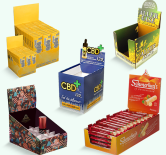

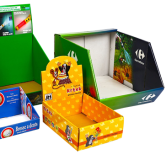
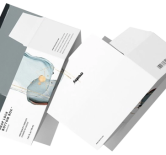
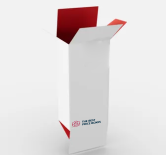
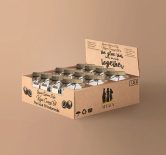

A custom display box is a printed retail container built to do two jobs at once: protect the product and sell it from the shelf or the checkout counter with no salesperson standing next to it. Most are made from corrugated or paperboard, die-cut so the front panel folds away to put the product on show, and printed with branding, a benefit line, and a price right where a shopper’s eye lands.
There isn’t one thing called a “display box.” A counter unit at a register, a four-foot floor stand in a grocery aisle, and a tear-away tray of protein bars are all display packaging, and they’re built to very different specs. This guide covers the main types, what they’re made of, how they’re printed, and which one actually fits the product you’re trying to move — plus why you don’t need to commit to a pallet of them to find out.
The main types of display boxes, and when to reach for each
Counter / PDQ displays. Counter displays — often called PDQ, for “pretty darn quick,” because they ship flat and pop open in seconds — sit by the register and catch impulse buys. The footprint is small, usually half a square foot to two square feet, so a retailer will actually give you the space. Think lip balm, lighters, phone accessories, gum, single-serve supplements. If the product is small, inexpensive, and bought on a whim, this is the format.
Floor-standing displays (FSDU). A floor-standing display unit stands on its own in the aisle or at an endcap and holds real inventory — often a full case or two. Because it carries weight and takes a beating from carts and restocking, it’s built from heavier double-wall board and usually ships in a few pieces you assemble in store. These earn their keep when you’ve negotiated floor space for a promotion or a seasonal push.
Shelf-ready / retail-ready packaging (SRP). Shelf-ready packaging is the case your product ships in, redesigned so a stocker can tear off a perforated top and drop the whole tray straight onto the shelf — no unpacking item by item. Grocery and warehouse-club buyers increasingly require it because it cuts their labor. If you sell into those channels, SRP often isn’t optional; it’s a line on the vendor spec.
Display lid boxes. A display lid box is a two-piece tray-and-lid where the lid is scored to fold back and become a riser or price card once the box is open. It’s the middle ground: it protects the product like an ordinary box in transit, then turns into a counter display when it lands. Bakeries, cookie and chocolate brands, and gift-set sellers use these because one box does both shipping and merchandising.
Dump bins. A dump bin is exactly what it sounds like — a deep open box, floor or countertop, that you fill loosely with product for a grab-and-go, everything’s-a-deal feel. They’re cheap to produce and hard to beat for clearance, seasonal candy, or a single SKU you’re pushing on price.
Peg hook display boxes. These have a reinforced punched hole or a header card so the unit hangs on a slatwall or pegboard. Common for hardware, accessories, and anything a store merchandises vertically instead of on a flat shelf.
What display boxes are actually made of
Nearly every display box is corrugated board, paperboard, or a combination, and the choice comes down to how much weight the unit carries and how fine the print needs to be.
Corrugated board is rated by flute — the wavy inner layer. E-flute is thin, about 1/16 inch, with a smooth face that takes high-resolution print well, so it’s the go-to for small counter displays where the graphics matter more than raw strength. B-flute, around 1/8 inch, is the workhorse for most counter and mid-size units: it prints cleanly and resists crushing. C-flute, about 3/16 inch, and double-wall BC board are for floor displays and anything holding real weight. As a rough rule, 32 ECT B-flute handles a loaded counter unit; step up to 44 ECT double-wall for a floor stand so it doesn’t buckle under a full load.
For a small, premium counter display — cosmetics, jewelry, high-end supplements — SBS paperboard (solid bleached sulfate) gives you a bright white surface and crisp print, sometimes in a rigid setup construction. It won’t hold a heavy load, but for a lightweight, good-looking unit at the register it beats corrugated on shelf appeal. Uncoated kraft board is the other end: it prints well in one or two colors and reads as natural and no-frills, which suits food, CBD, and refill-style brands.
Printing and finishing that earns the sale
A display box only works if it stops someone mid-stride, so the print does the heavy lifting. Offset and digital printing both hit full CMYK; digital is faster and cheaper for shorter runs, offset stays more consistent across a big one. A matte or gloss laminate protects the surface from scuffing during restocking, and spot UV or foil on a logo or a “SALE” burst adds the shine that catches overhead store lighting. Keep the message short — a shopper reads a display in about three seconds, so the product name, one benefit, and the price need to be legible from a few feet away.
Who leans on display boxes
Beauty brands use counter displays at salon checkouts and beauty-aisle endcaps. Supplement and CBD companies use them to launch a new SKU without buying permanent shelf space. Food, candy, and bakery brands use display lid boxes and dump bins for impulse and seasonal buys. Electronics-accessory sellers use peg hook units. Pharmacies and health retailers use medicine and OTC display boxes to line up small, similar-looking packages so shoppers grab the right one fast. If a product is small, bought on impulse, or fighting for attention against ten near-identical options, a display box is usually part of the answer.
No minimum order: test a display before you commit to a pallet
Here’s where most manufacturers make display boxes hard — they quote a 500 or 1,000-unit minimum, which is a lot of commitment for a format you’re still testing. We don’t set one. You can order a handful of custom display boxes to trial in a single store, see how they perform, then scale to a full run on the same pricing structure. Being The Best Price Boxes, the whole point is that you shouldn’t have to overpay or overorder to find out whether a display moves product. Get the design and the specs right on a small batch first, then commit.
If you already know the product and the retail setting, tell us the type — counter, floor, shelf-ready — the rough dimensions, and the weight it needs to hold, and we’ll spec the board and quote it. If you’re not sure which format fits, that’s what the guide above is for, and we’re glad to talk it through before you order.
Custom Display Boxes FAQ
Is there a minimum order for custom display boxes?
No. The Best Price Boxes produces custom display boxes with no minimum order quantity, so you can trial a small batch of counter units in one store and scale to a full run later on the same pricing structure.
What’s the difference between a PDQ (counter) display and a floor display?
A PDQ, or counter, display is a small unit that sits by the register for impulse buys and takes up roughly half a square foot to two square feet. A floor-standing display stands on its own in the aisle, holds a case or more of product, and is built from heavier double-wall board to carry the weight.
What material and ECT rating should a display box be?
Small counter units are usually B-flute or E-flute corrugated at around 32 ECT, or SBS paperboard for a premium look. Floor displays that hold real weight need C-flute or double-wall BC board rated 44 ECT or higher so the unit doesn’t buckle under a full load.
What is shelf-ready packaging (SRP)?
Shelf-ready or retail-ready packaging is a shipping case designed so a store employee can tear off a perforated top and place the whole tray straight onto the shelf without unpacking each item. Grocery and warehouse-club buyers often require it because it cuts their restocking labor.
How fast can I get custom display boxes?
Turnaround depends on the display type, the printing, and the quantity. Send us the format and dimensions and we’ll confirm the exact lead time along with your quote.