






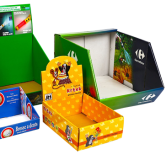


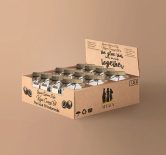
Yes, The Best Price Boxes makes custom display boxes with no minimum order, and we will beat any written quote you already have. A display box has a different customer from every other box we make. It has to persuade a shopper, but first it has to persuade a retailer to give it space, and retailers judge displays on how little work they create. That is why the retail ready standard the trade uses is built around five practical tests, and why a display that fails them never reaches the shelf.
Custom display box specs
| Spec | What you get |
|---|---|
| Minimum order | None. Print one display for a pitch or a trade show before committing. |
| Formats | Counter display units, shelf ready cases, tear away display shippers, floor standing displays, pallet displays, dump bins, power wings. |
| Board | Corrugated E, B and C flute, double wall for floor and pallet displays, litho laminated where print quality matters. |
| Printing | Full color litho laminated or digital for photographic quality, flexo for economy on plain shippers. |
| Structure | Perforated tear lines, locking tabs, glued or slotted assembly, header cards and risers. |
| Inserts | Trays, dividers, gravity feed chutes and stepped platforms so product faces forward as stock depletes. |
| Assembly | Ships flat or pre packed. We design for the number of steps store staff can realistically be asked to do. |
| Finishes | Aqueous coating, matte and gloss lamination on litho laminated work, spot varnish. |
| Design | Free. Die lines, 3D mockups and revisions included. |
| Samples | Free, and essential. A display has to be assembled and loaded to be judged. |
| Shipping | Free. |
The five tests a retailer applies
Shelf ready and retail ready packaging is assessed across the grocery and retail trade against five practical criteria, usually described as easy to identify, easy to open, easy to shelf, easy to shop and easy to dispose of. They are worth knowing because they are the actual reason displays get rejected.
Easy to identify. Store staff have to know what is in the case without opening it, from a distance, in a busy stockroom. Product name and variant on more than one face, large.
Easy to open. One perforated tear line, opened without a knife, in a few seconds, with a clear starting point. If a member of staff needs a blade, you have failed this test and risked cutting the product.
Easy to shelf. The case goes onto the shelf as a unit and fits the shelf depth and height. Anything that has to be unpacked item by item costs the retailer labor and will be refused or deprioritized.
Easy to shop. The shopper can see and reach the product. Front panels cut low enough, product facing forward, no reaching into a deep box.
Easy to dispose of. The empty case collapses flat quickly and goes into one recycling stream. Mixed materials and stubborn assemblies are a real objection.
Design against those five and your display gets space. Design a beautiful structure that fails two of them and it will not.
Display formats and what each is for
| Format | Where it sits | Best for |
|---|---|---|
| Counter display unit | Checkout or counter | Impulse purchases, small high margin items, samples |
| Shelf ready case | On the shelf as a unit | Grocery and pharmacy lines, anything replenished frequently |
| Tear away display shipper | Ships as a case, becomes a display | The most efficient format. One box does transit and merchandising |
| Floor standing display | Aisle end or open floor | Promotions, launches, seasonal ranges |
| Pallet display | Delivered on a pallet, placed as one unit | High volume promotions, warehouse clubs |
| Dump bin | Floor or counter | Single line bulk product, price led offers |
| Power wing | Clipped to a shelf end | Small add on lines beside a related category |
If you are choosing for the first time, the tear away display shipper is usually the right answer. It removes a second box, a second freight cost and a whole step of store labor, and it is the format retailers most readily accept.
Structure, and why displays fail
The two failure modes are collapse and refusal.
Collapse is a board problem. A floor standing display carries its own weight plus the product above every shelf, over days or weeks, in whatever humidity the store has. Corrugated loses compression strength as it takes up moisture, so a display that stands firm in a dry warehouse can sag on a shop floor in summer. Specify double wall for floor and pallet displays, and add a plinth or a reinforced base under any column of stock.
Refusal is a labor problem. Every additional assembly step increases the chance a display sits in a stockroom instead of on the floor. Count the steps in your own sample honestly. If assembly takes more than a couple of minutes without instructions, redesign it.
Facing and gravity feed
A display that looks full at the start and empty at the third purchase has wasted most of its value. Two structural answers keep it selling.
A stepped platform raises the back rows so product stays visible as the front sells through. A gravity feed chute angles the base so units slide forward automatically. Gravity feed is the better solution for uniform items like cans, tubes and boxed units, and it needs a tested angle, because too shallow and nothing moves, too steep and units tip.
Both cost little and both extend the useful life of a display considerably.
Printing
Displays are seen from a distance and judged in a second, so print quality and contrast matter more than on a shipper. Litho lamination gives photographic quality on a corrugated structure and is the standard for retail displays with real budget. Digital printing is the direct route for shorter runs and is what makes no minimum orders possible here. Direct flexo suits plain shippers and simple line work but will show a faint ridged pattern across large solid areas on coarser flutes.
The header card is the part that earns its cost. It sits at eye level, it carries the message, and it is the first thing seen from down the aisle. Spend there before spending on the base.
What a display box is not right for
It is not a substitute for retailer agreement. Build a display before you know the shelf dimensions, the aisle rules and the store’s assembly policy and you may produce something that cannot be placed.
It is not a shipper unless it is designed as one. A display that travels inside a separate case doubles your freight and your board.
And it is not right for a product with an uncertain range. A display is tooled to a specific product footprint and count, so a range still changing shape will outrun its die line.
Related packaging
See corrugated boxes for the material and grades, shipping boxes for transit cases, window boxes for product visibility at unit level, and cardboard boxes for the wider range.
Frequently asked questions
What is a display box?
Packaging designed to present product at the point of sale rather than simply contain it. It ranges from a small counter unit to a floor standing display or a pallet display, and the most efficient version is a shipper that tears away to become the display itself.
What makes a display retail ready?
The trade assesses it on five criteria: easy to identify, easy to open, easy to shelf, easy to shop and easy to dispose of. A display that fails two of those will struggle to get space regardless of how it looks.
Do you have a minimum order for display boxes?
No. There is no minimum, which matters here because you often need one physical display to show a buyer before any volume is agreed.
Why do floor displays sag?
Usually humidity. Corrugated loses compression strength as it takes up moisture, so a display that stands firm in a dry warehouse can sag on a shop floor. Specify double wall for floor and pallet displays and reinforce the base under any column of stock.
How do I keep the display looking full?
Use a stepped platform to raise the back rows, or a gravity feed chute that slides product forward as the front sells. Both cost little and both extend how long the display keeps selling.
Can you beat a quote I already have?
Yes. Send the written quote with the specification and we will beat it on a like for like build. We will also count the assembly steps in the design you have been quoted, because a display store staff will not build is not a saving.
Get a quote for custom display boxes
Tell us the product, the count per display, where it will stand, the shelf or floor dimensions you have to work within, and whether it needs to ship as its own case. Design, samples and shipping are free, there is no minimum order, and we will design against what retailers actually accept rather than what looks best in a rendering.
No-minimum packaging by product
Same promise across every product line: no minimum order, a free quote, and we will work to beat your current price.
- Custom Boxes With No Minimum Order
- Mailer Boxes With No Minimum Order
- Mylar Bags With No Minimum Order
- Food Boxes With No Minimum Order
- Rigid Boxes With No Minimum Order
- Kraft Boxes With No Minimum Order
- Soap Boxes With No Minimum Order
- Candle Boxes With No Minimum Order
- Gift Boxes With No Minimum Order
- Coffee Boxes With No Minimum Order
- Cosmetic Boxes With No Minimum Order
- CBD Boxes With No Minimum Order
- Candy Boxes With No Minimum Order
- Subscription Boxes With No Minimum Order
- Cake & Bakery Boxes With No Minimum Order
- Stand-Up Pouches With No Minimum Order
- Apparel Boxes With No Minimum Order
- Jewelry Boxes With No Minimum Order
- Supplement Boxes With No Minimum Order
- Vape Boxes With No Minimum Order